

Kenya's Bold Plan to Transform Refugee Camps Into Cities Leaves the Most Vulnerable Behind
Kakuma, 10 June 2026
Kenya’s Shirika Plan promises to turn Kakuma and Dadaab refugee camps into integrated settlements, offering freedom and opportunity. Yet for women — particularly minority refugees — basic safety remains unaddressed, exposing a dangerous gap between policy ambition and lived reality.
A 35-Year Experiment in Containment
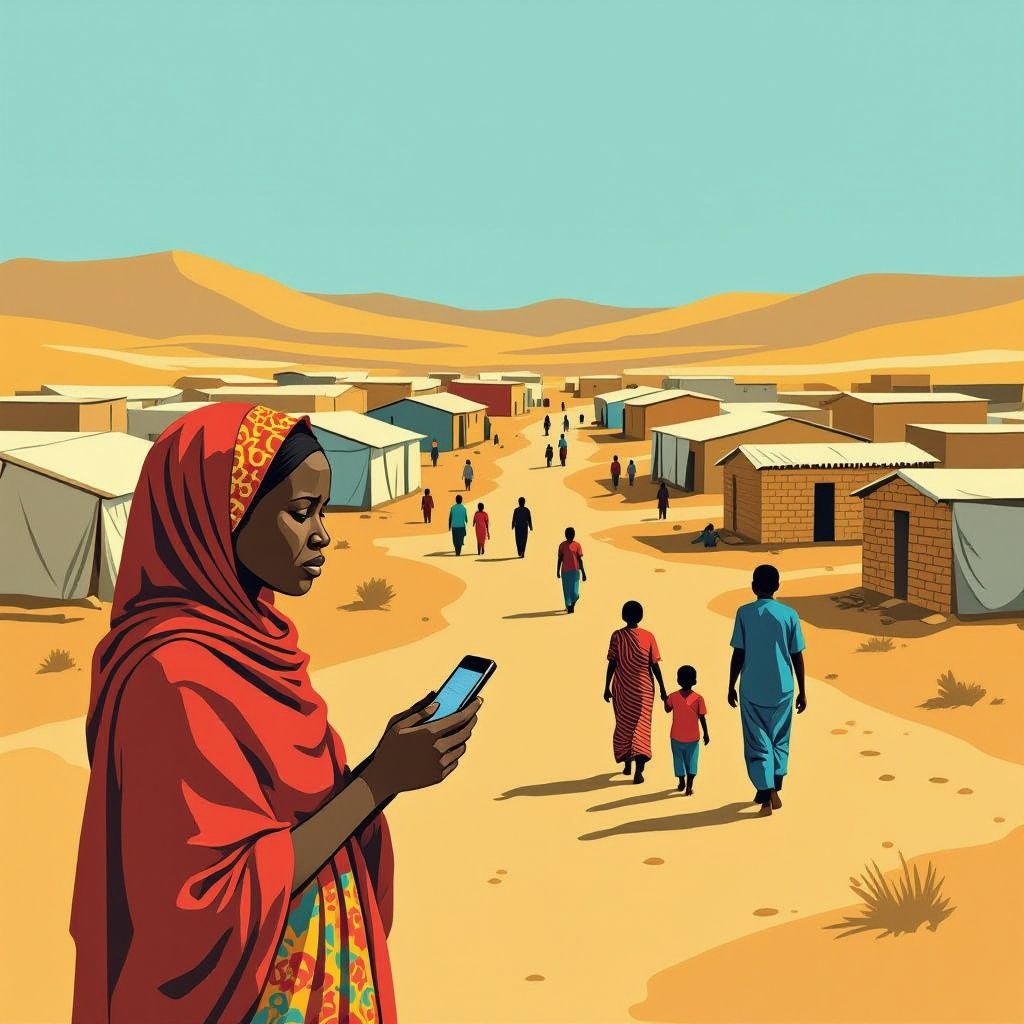
Dadaab, established in 1991 in northeast Kenya, is now 35 years old as of 2026 — and for much of that time, it has functioned less as a temporary refuge and more as a permanent city without the infrastructure of one [1]. The complex spans three camps — Dagahaley, Ifo, and Hagadera — and today hosts more than 400,000 people [1]. Yet the Kenyan government has consistently refused to permit permanent infrastructure, street lighting, or even locks on doors [1]. One resident has lived in Dagahaley since the camp’s founding in 1991, raising three children across 35 years inside its boundaries [1]. Another arrived in 2007 and remains there still [1]. These are not outliers — they are the norm in a system that was designed to be temporary but has become generational [GPT].
What the Shirika Plan Actually Promises
In March 2025, the Kenyan government and UNHCR jointly launched the Shirika Plan — a multi-year policy framework that formally commits to transitioning both Dadaab in Garissa County and Kakuma in Turkana County away from the traditional encampment model [1]. The plan promises refugees the freedom of movement, the right to formal employment, and access to government-run services alongside host communities [1]. In both Kakuma and Kalobeyei — the newer, more planned settlement adjacent to Kakuma — residents can expect gradual shifts in how healthcare, education, water, and food assistance are delivered, moving from UNHCR-managed humanitarian provision towards county government and community-based systems [GPT]. The ambition is substantial: transforming two of Africa’s largest and most entrenched refugee complexes into functioning integrated municipalities is a policy undertaking with few global precedents [GPT].
Donor Praise, Unresolved Financing
By March 2026 — a full year into the Shirika Plan’s life — international donors had offered considerable praise for the framework’s vision [1]. Yet the plan’s implementation continues to rely on financing that remains unsecured, including expected contributions from the World Bank and private sector partners [1]. No confirmed funding arrangements for the most basic safety infrastructure — lockable doors, lit pathways, or household-level water and latrine access — have been reported as of the date of publication [1]. This gap between high-level political endorsement and ground-level delivery is not a minor administrative detail. For the more than 400,000 people in Dadaab alone [1], and for the hundreds of thousands more across Kakuma and Kalobeyei [GPT], the absence of secured funding means the daily realities of camp life remain largely unchanged more than a year after the plan’s launch.
Invisible by Necessity: How Women Survive
In March 2025, a researcher conducted interviews with 29 women in Dadaab, deliberately oversampling minority nationalities — South Sudanese, Ethiopian, Burundian, Rwandan, and Congolese — who together make up approximately 4% of the camp population and face disproportionately high rates of sexual and gender-based violence [1]. What emerged from that fieldwork was a taxonomy of survival strategies built not on agency but on erasure. Researchers identified four distinct practices: ‘religious passing’, in which Christian minority women adopt Somali Muslim dress, speech, and public behaviour to avoid economic exclusion and hostility; ‘temporal withdrawal’, which involves restricting movement after dark and even reducing food and water intake to avoid unlit 50-metre walks to latrines at night; ‘delegated visibility’, in which children are sent as proxies to collect water and rations; and ‘spatial contraction’, a near-total confinement to blocks of between 100 and 150 households [1]. One woman had not left her shelter — except to use the latrine — from January 2024 through to the time of the March 2025 interviews, a period of 14 months [1]. Data from a major study cited in the research indicates that close to 67% of refugee women in the Dadaab complex have experienced intimate partner violence [1].
The Education Crisis Compounding Vulnerability
The structural vulnerabilities facing women in Dadaab do not exist in isolation — they intersect with a broader education crisis that defines the futures of young refugees across Africa and beyond. As of June 2026, of the 12.4 million school-aged refugee children worldwide, nearly half are out of school entirely, and only 37% reach secondary education [2]. Africa is home to nearly one third of the world’s refugees [2], meaning the continent bears a disproportionate share of this educational deficit. For the children of women like those interviewed in Dadaab — children deployed to fetch water and food in place of their mothers — formal schooling becomes not only logistically difficult but structurally incompatible with the survival strategies families are forced to adopt [1][2]. The ‘delegated visibility’ strategy, whereby mothers send children on errands they are too unsafe to complete themselves, directly competes with school attendance [1].
What the Policy Misses — and What Residents Should Watch
The Shirika Plan, as currently structured, does not address the specific safety infrastructure deficits that drive these survival strategies [1]. There are no confirmed provisions for lockable doors, household latrines, or lit pathways in Dadaab as of June 2026 [1]. A male UNHCR officer in Dadaab, when questioned about the camp’s majority-female population and the specific risks it faces, reportedly responded: ‘What do you want? They are the majority’ [1] — a remark that encapsulates the institutional indifference researchers have documented in the field. The comparative dimension is also notable: ongoing fieldwork in four internally displaced persons camps near Abuja, Nigeria, has identified a structurally similar pattern, where displaced women face state-imposed invisibility and lack of basic services [1], suggesting this is not a Kenya-specific failure but a systemic one across African displacement contexts. For residents of Kakuma and Kalobeyei specifically, official guidance continues to direct residents to follow announcements from UNHCR and the Department of Refugee Services (DRS) regarding registration updates, changes to ration arrangements, and documentation requirements as the Shirika Plan’s implementation progresses [GPT]. Meanwhile, academic documentation of these conditions is continuing: researcher Fabienne Hoelzel’s chapter, ‘Invisible by Necessity: Tactical Disappearance and the Embodied Politics of Survival in Dadaab’, is scheduled for publication in the volume ‘Improvised Urbanism’ by Routledge in 2026 [alert! ‘No specific publication month in 2026 is confirmed in the source material’]. One woman interviewed in Dagahaley, who has lived inside the camp since 1991, offered a summary of her own hopes that no policy document has yet matched in honesty: ‘I lost hope for myself. But at least my children should be able to escape the refugee reality’ [1]. The Shirika Plan’s promise to transform Kakuma and Dadaab into integrated settlements is the most ambitious shift in Kenyan refugee policy in decades. Whether it delivers for those most at risk — women, minorities, and the structurally invisible — will depend on whether the gap between its language and its infrastructure is closed with urgency, not deferred behind unsecured financing and donor applause.