

Japan and Kenya Join Forces to Bring Safe Toilets to Half a Million Refugees
Nairobi, 8 June 2026
A landmark deal signed on 8 June 2026 between JICA and LIXIL targets 500,000 people with safe sanitation, as unsafe toilets currently kill over 1,000 children daily worldwide.
A Deal Signed in Tokyo, Felt in Kakuma
On 8 June 2026, in Tokyo, two organisations with very different origins arrived at a shared conclusion: that the global sanitation crisis demands a fundamentally new approach. Akihiko Tanaka, President of the Japan International Cooperation Agency (JICA), and Kinya Seto, President and CEO of LIXIL Corporation, signed a Memorandum of Understanding (MOU) establishing a public-private cooperation framework to address water, sanitation, and hygiene (WASH) challenges in developing countries [1]. The agreement is not merely symbolic. It sets in motion an initial operational phase targeting homes, schools, healthcare facilities, and refugee and host communities — beginning in Kenya and Malawi — with the ambition of eventually delivering safe sanitation to 500,000 people across Africa, the Middle East, and Asia [1].
The Scale of the Problem
To understand why this agreement matters, the numbers must be confronted directly. Globally, approximately 3.4 billion people currently lack access to safely managed sanitation [1]. The consequences of that gap are not abstract: diarrhoeal diseases caused by unsafe sanitation and poor hygiene kill more than 1,000 children every single day, amounting to approximately 440,000 child deaths annually [1]. That means that in the time it takes to read this article, another child’s life will likely be lost to a preventable, sanitation-related illness. It is against this backdrop that the JICA-LIXIL partnership has been designed — not as a charitable gesture, but as an attempt to construct what both organisations are calling a self-sustaining ‘Sanitation Economy’ [1].
What the ‘Sanitation Economy’ Actually Means
The phrase ‘Sanitation Economy’ is central to understanding the strategic logic of this MOU. Rather than building facilities and walking away — an approach that JICA’s own President acknowledged has historically failed to ensure hygiene practices take root — the partnership seeks to establish locally managed systems for toilet manufacturing, sales, and installation [1]. LIXIL’s social enterprise arm, SATO, already operates this model across 59 countries and territories, having improved sanitation and hygiene conditions for over 103 million people through affordable products including the SATO Pan and the SATO Tap [1]. The combination of JICA’s institutional development expertise and governmental relationships with LIXIL’s product development and market-creation capabilities is, according to both signatories, specifically designed to move beyond conventional aid dependency [1].
Kenya’s Kakuma Camp and the Shirika Plan Connection
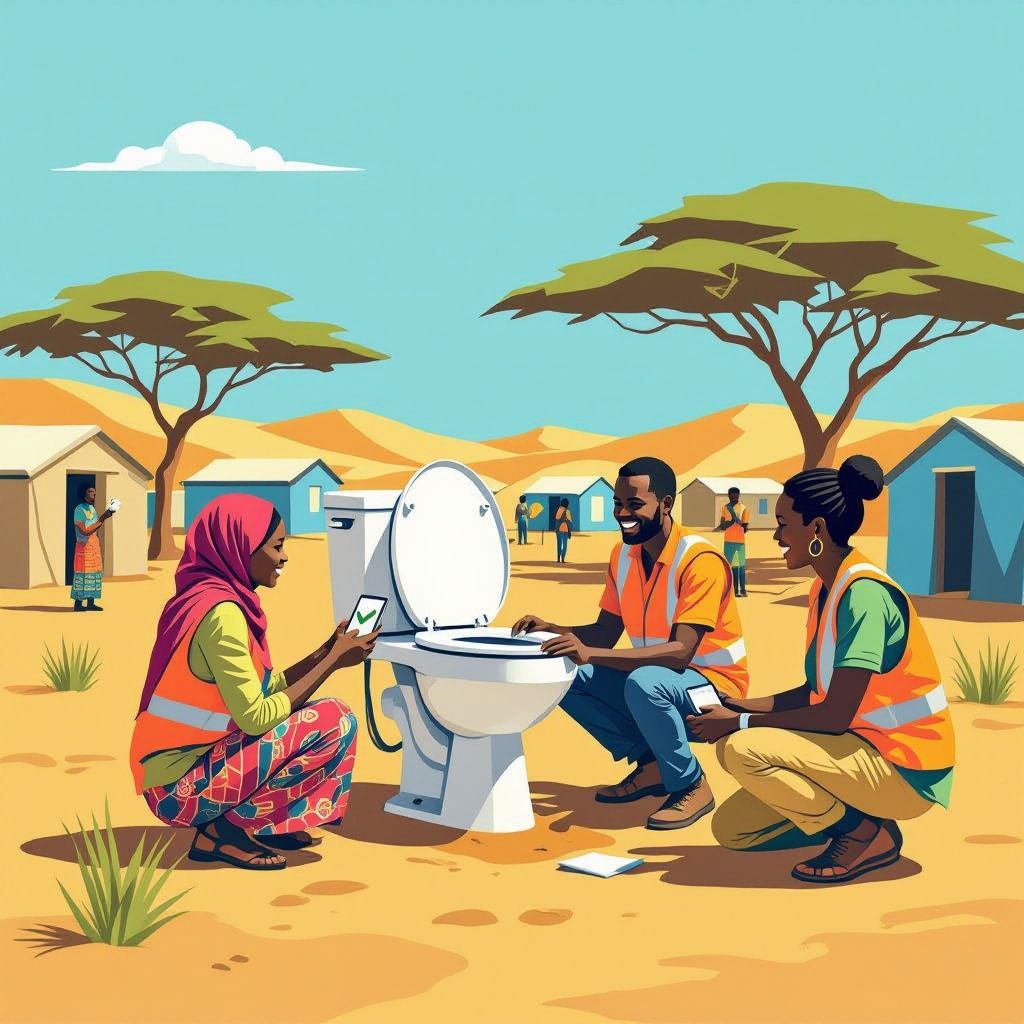
Within Kenya, the partnership has a clear geographic and policy anchor. The initial phase explicitly targets refugee communities aligned with the Kenyan government’s ‘Shirika Plan’ at the Kakuma refugee camp [1]. The Shirika Plan represents a structural shift in Kenya’s approach to refugee management, moving away from a containment model and towards one that enables refugees to participate in economic activities, access formal employment, and benefit from national public services [GPT]. For the residents of Kakuma — and separately, the planned settlement of Kalobeyei [alert! ‘The source material explicitly references Kakuma in connection with the Shirika Plan but does not separately name Kalobeyei as a target site within the MOU text; inclusion of Kalobeyei is drawn from contextual background about the Shirika Plan’s geographic scope’] — the arrival of improved toilet and handwashing infrastructure represents one of the most immediate and tangible expressions of that broader inclusion policy.
Jobs, Self-Reliance, and a 2031 Deadline
The MOU is notable not only for its sanitation targets but also for its explicit emphasis on job creation and refugee self-reliance [1]. By establishing locally managed sanitation supply chains — covering manufacturing, distribution, and installation — the partnership is designed to generate economic activity within and around refugee-hosting communities, rather than importing solutions from outside. LIXIL has set a formal corporate target to improve sanitation and hygiene for the ‘next 100 million people’ by the fiscal year ending March 2031 [1]. The Kenya and Malawi programmes are intended to serve as the proving ground for a model that, if successful, is earmarked for expansion across Africa, the Middle East, and Asia [1]. As Kinya Seto stated at the signing: ‘To address complex and profound global challenges, including sanitation access, refugee self-reliance, and climate change, we must further accelerate the creation of a market-driven Sanitation Economy that grows autonomously on the ground’ [1].
What Comes Next
With the MOU now formally signed as of 8 June 2026, the immediate next steps involve the rollout of the initial phase across target communities in Kenya and Malawi, focusing on homes, schools, and healthcare facilities [1]. JICA and LIXIL have also committed to continuously exchanging information on water and sanitation needs and countermeasures in developing countries, with the stated aim of improving project quality and social implementation over time [1]. Beyond the operational targets, the partnership is positioned to contribute to the United Nations Sustainable Development Goals (SDGs), with both organisations pledging to promote global understanding and drive behavioural change around water and sanitation [1]. The broader trajectory is clear: a landmark agreement signed in Tokyo on a Monday morning in June 2026 has set a clock ticking — one measured not in diplomatic communiqués, but in the number of people who gain access to a safe toilet before March 2031, a figure that both JICA and LIXIL have staked their reputations on reaching [1].