

How Cutting Food Aid by 60% Turned a Kenyan Refugee Camp into a Conflict Zone
Kakuma, 11 June 2026
When food rations were slashed in Kakuma, protests erupted and people died. Research now links abrupt aid cuts directly to rising violence, threatening millions more across Africa.
A Single Decision, Devastating Consequences
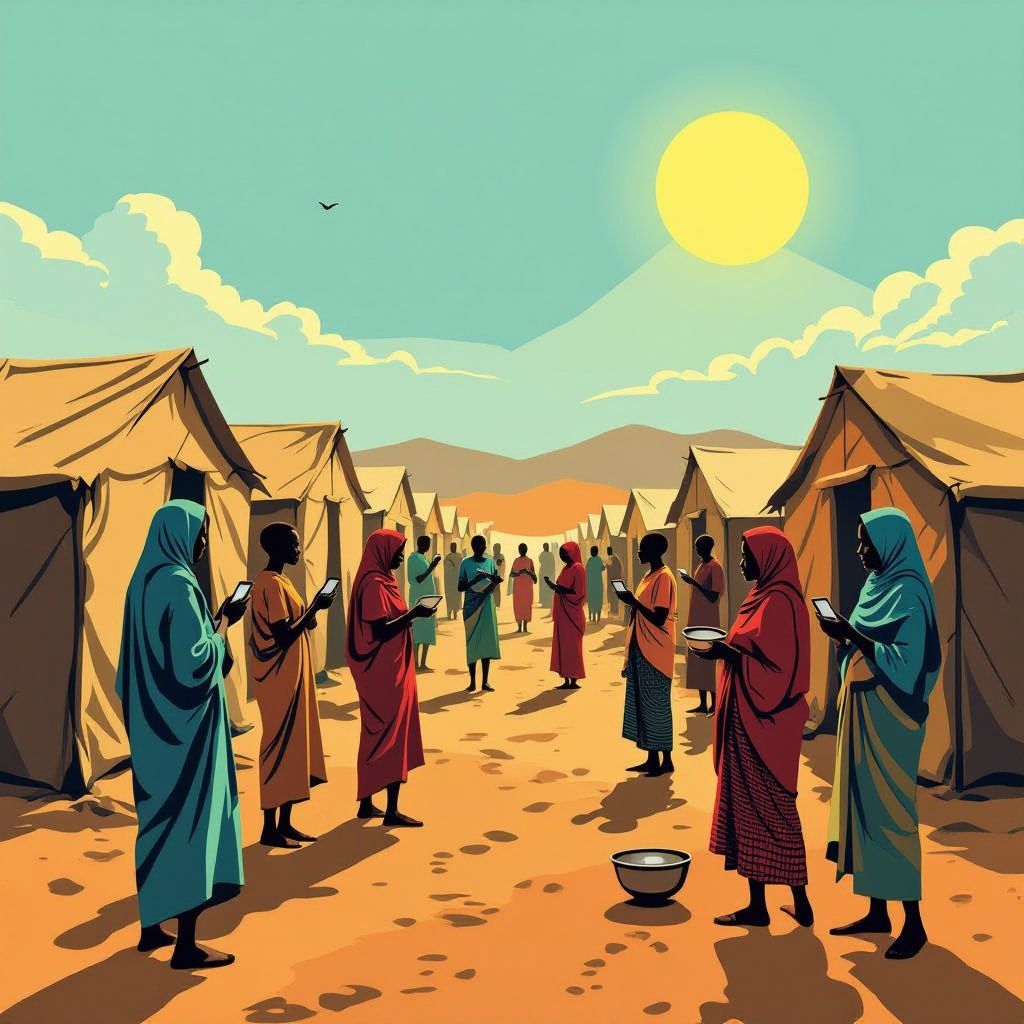
In July 2025, the World Food Programme (WFP) reduced food rations by 60% and simultaneously suspended cash assistance at Kakuma Refugee Camp in northern Kenya [1]. The immediate aftermath was not quiet desperation — it was open conflict. Protests erupted across the camp, and by the time order was restored, two people were dead and more than 12 had been injured [1]. The trigger for those WFP cuts was itself abrupt: a stop-work order issued by the United States government in January 2025, which severed a critical thread in the fabric of humanitarian funding across East Africa [1]. For the residents of Kakuma — one of the world’s largest and longest-running refugee camps — the sequence of events laid bare a brutal truth: when aid disappears without warning, survival itself becomes a battleground [GPT].
The Science Behind the Violence
What happened in Kakuma in mid-2025 was not an isolated incident, nor was it unpredictable. A peer-reviewed study published in the journal Science has directly associated sudden aid cuts in Africa with measurable spikes in violence and instability [1]. According to that research, abrupt reductions in humanitarian funding are linked to a 16.9% rise in fights, a 12.3% increase in armed clashes, a 9.3% upturn in mortality, and approximately 10% more riots [1]. The Centre for Global Development has gone further, attributing around 1,000 deaths to the conflicts that followed such withdrawals [1]. Austin Wright, a co-author of the Science study, described the mechanism with stark clarity, warning that a sudden aid cut “shuts down the local economy, obliterates wages, and destroys what we call the outside option” [1] — meaning that when people lose both food support and any realistic economic alternative, the conditions for violence become almost structurally inevitable.
Kakuma and Kalobeyei: A Region Under Pressure
Kakuma Refugee Camp and the adjacent Kalobeyei settlement, both located in Turkana County in northern Kenya, serve as home to hundreds of thousands of displaced people [GPT]. The July 2025 ration cuts affected both communities, though it is Kakuma where the street protests and resulting casualties have been most explicitly documented [1]. For residents of Kalobeyei — a more structured, integrated settlement model introduced as a longer-term alternative to traditional camp living — the cuts were equally destabilising, arriving without a phased transition or compensatory mechanism [alert! ‘Source material does not provide specific detail on Kalobeyei protest activity or casualties separately from Kakuma; distinction is drawn from general knowledge of the two sites’]. The broader humanitarian picture in Kenya is severe: as of 9 June 2026, the United Nations in Kenya reported that up to 45 million people globally are at risk of acute hunger, describing the situation as “a new hunger crisis unfolding” [2]. Food access, the UN noted, remains critical not only for immediate survival but for health, education, and livelihoods [2].
When Aid Is the Infrastructure
One of the most sobering dimensions of this crisis is the degree to which affected states have come to depend structurally on external assistance — not as a supplement, but as the core architecture of survival. In South Sudan, Somalia, and the Democratic Republic of the Congo, external aid has historically financed between 70% and 80% of healthcare, food systems, and humanitarian operations [1]. The January 2025 US stop-work order destabilised human security across all three of those countries simultaneously [1]. The consequences of abrupt withdrawal are not limited to the African continent: prior to 2021, international aid made up roughly 40% of Afghanistan’s gross domestic product and covered over 75% of government expenditure, before the economy contracted by approximately 27% [1]. These figures illustrate that in highly fragile contexts, foreign aid is not, as one unattributed voice in development policy circles put it, “a luxury supplement” — it “forms the core infrastructure of daily survival” [1].
The Road Ahead: Projections and the Case for Responsible Exit
The trajectory, if current trends continue, is deeply concerning. Aid reductions are projected to push an additional 5.7 million Africans into extreme poverty by 31 December 2026, with that figure rising to 19 million by 2030 — a development that analysts warn will further deepen security vacuums in already fragile regions such as the Sahel [1]. Against this backdrop, development policy circles are coalescing around what they term a “responsible exit” doctrine, a framework supported by the Organisation for Economic Co-operation and Development (OECD) [1]. The core argument is straightforward: donors must transfer systems and financing responsibilities gradually, rather than terminating support abruptly in contexts where aid dwarfs foreign direct investment and remittances [1]. There is historical precedent for success. During the 2010s, donor-supported HIV programmes — including elements of the United States President’s Emergency Plan for AIDS Relief (PEPFAR) in middle-income countries — were phased out over several years, allowing local governments to progressively assume financing responsibilities [1]. Health policy researchers have confirmed that slower transitions reduce service disruption and preserve institutional continuity [1]. The challenge now is that the international system still lacks agreed standards for managing withdrawal in fragile environments, even as global aid budgets continue to tighten [1]. For Kakuma and Kalobeyei, and for the millions of people across East Africa watching those negotiations unfold, the pace of that transition is not an abstract policy question — it is a matter of life and death.