

Turkana County Takes Control of Critical Hospital Oxygen Supply as Foreign Funding Dries Up
Lodwar, 11 June 2026
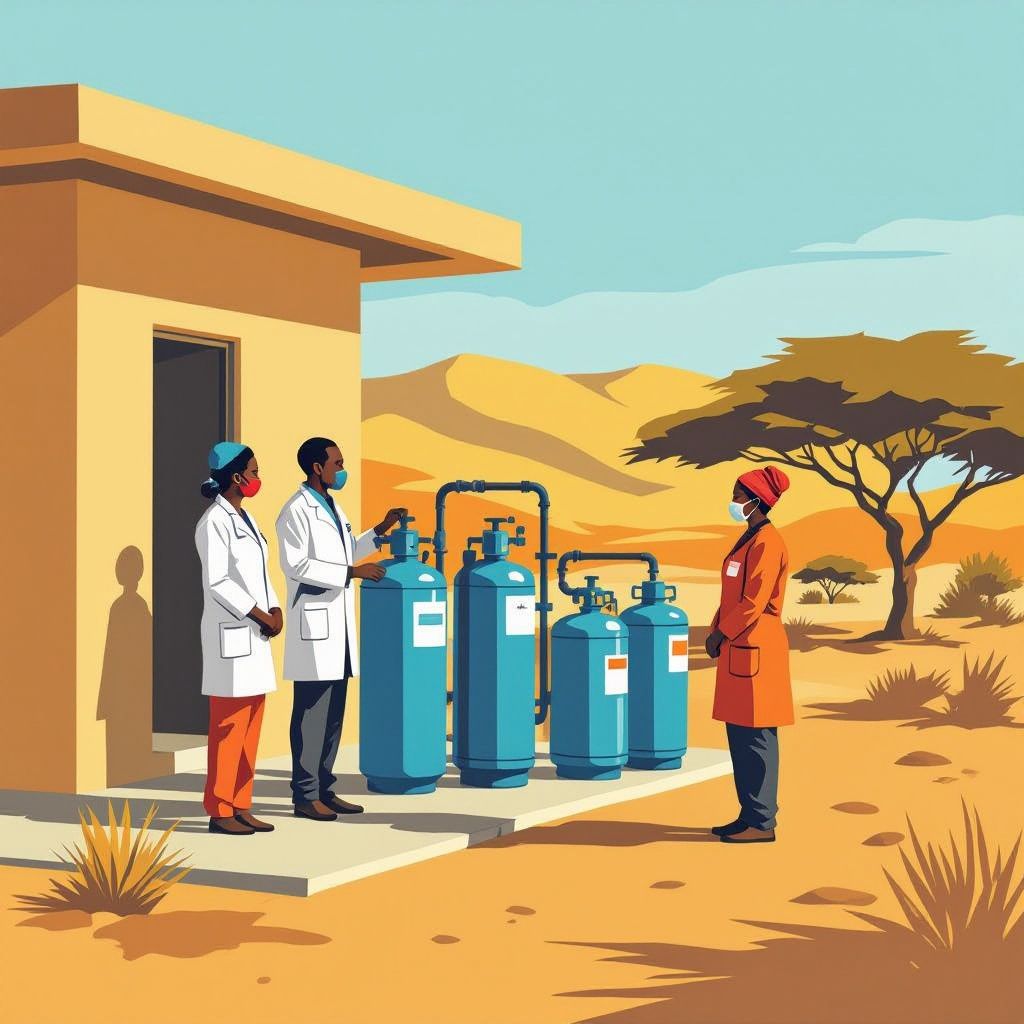
Turkana County has stepped in to independently maintain its only referral hospital’s oxygen plant, serving over 200,000 residents, after US funding cuts ended international support — a telling sign of aid dependency pressures across Kenya.
A County Steps Into the Breach
On 10 June 2026, the Turkana County Department of Health and Sanitation Services announced it would take over full responsibility for servicing the oxygen plant at Lodwar County Referral Hospital (LCRH), following the formal conclusion of a maintenance contract held by international health contractors CHEMONICS/Jhpiego [1][5]. The plant had been maintained by CHEMONICS/Jhpiego since its installation approximately three years ago, with funding provided by the United States Agency for International Development (USAID) [1]. However, following sweeping USAID funding cuts in 2025, the organisation’s maintenance contract was not renewed, leaving the county government with a clear choice: absorb the costs itself or risk the collapse of a facility that underpins life-saving care for a vast and vulnerable population [1].
What the Funding Gap Means in Practice
The decision to self-fund maintenance is not merely administrative — it marks a structural shift in how Turkana County must now approach healthcare infrastructure. The Director for Health Products and Technologies, Dr David Moru, acknowledged the gravity of the commitment during the 10 June 2026 meeting. “The oxygen plant remains a vital investment in our healthcare system. We are committed to ensuring its continued operation and maintenance so that our residents continue to access lifesaving oxygen services whenever they need them,” he said [1]. For a county covering 77,000 square kilometres — making it the second largest in Kenya — sustaining centralised medical infrastructure without international financial backing represents a significant budgetary and logistical undertaking [1][2][3][4].
Concern Worldwide’s Eight-Year Exit and the Sustainability Question
Closely mirroring the dynamics at LCRH, international NGO Concern Worldwide formally concluded nearly eight years of programming in Turkana on 10 June 2026, with the county government pledging to sustain the development gains achieved under the partnership [2]. The scale of Concern Worldwide’s footprint in Turkana was considerable: over the course of its programming, the organisation reached approximately 20% of Turkana’s population, providing food assistance to 66,899 households, nutrition interventions to 104,397 people, WASH (water, sanitation, and hygiene) programmes to 129,992 people, and livestock production support to 98,098 households [2]. These figures illustrate just how deeply embedded external NGO support has become in the daily lives of Turkana’s residents — both the settled host community and the refugee population hosted in the county [2].
Water Governance, New Talent, and Deeper Institutional Reform
While the county government manages the departure of Concern Worldwide and absorbs the LCRH oxygen plant’s maintenance costs, it is simultaneously investing in the next generation of local water sector professionals. The Horn of Africa Groundwater for Resilience Project (HOAGW4RP) announced on 10 June 2026 that it will deploy 20 new interns across all Turkana sub-counties during June 2026 to strengthen water governance and sustainability [3]. The interns were selected from a pool of 172 applicants following a shortlisting exercise conducted between 18 and 19 May 2026, with 60 candidates subsequently shortlisted and interviewed over two days on 8 and 9 June 2026 [3]. Of the 60 shortlisted candidates, 44 were male and 16 were female, drawn from Turkana North, South, East, West, Central, and Loima sub-counties [3].