

Mohamed Salah to Leave Liverpool After the World Cup as New Coach Iraola Promises the 'Heavy Metal' Football the Egyptian Demanded
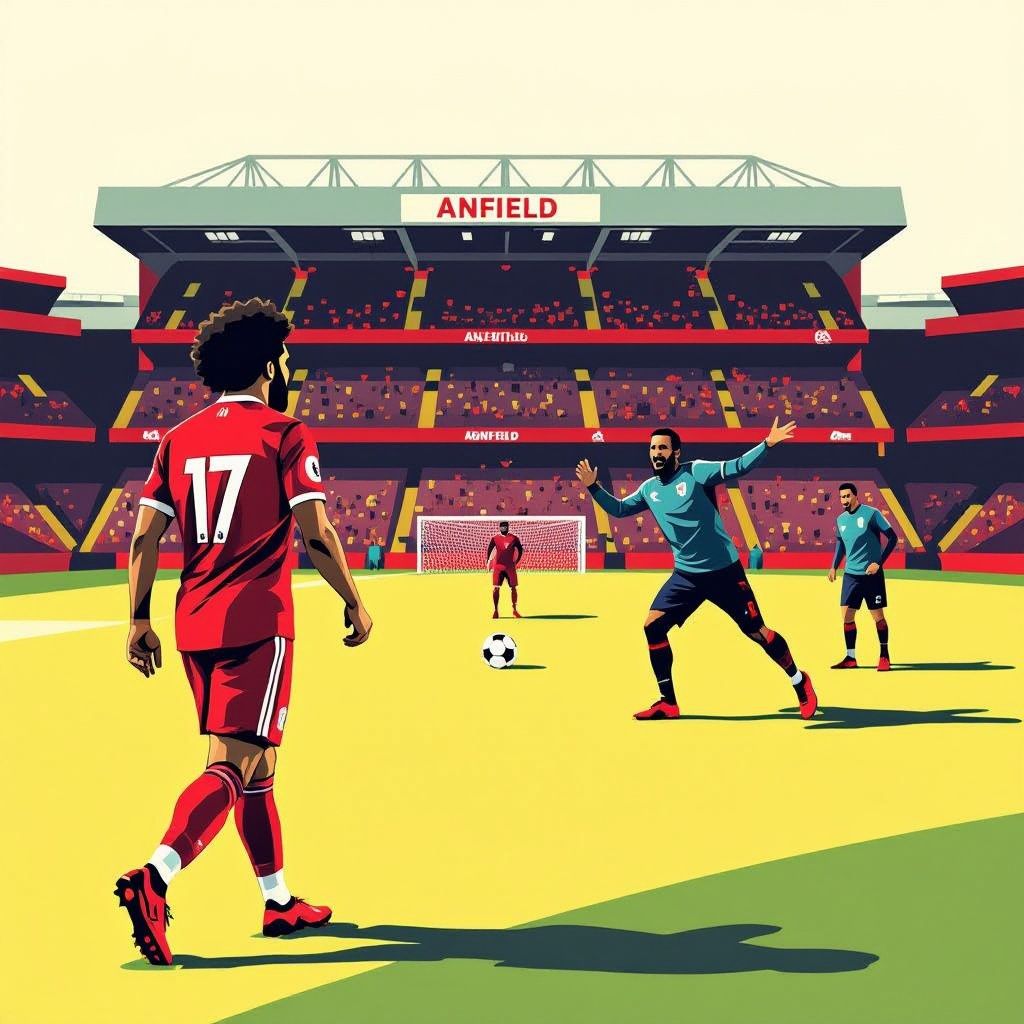
Liverpool, 6 June 2026
Mohamed Salah will depart Liverpool after the 2026 World Cup, having seen his key demand met: the sacking of manager Arne Slot and the appointment of high-intensity coach Andoni Iraola. Salah’s future is decided, but he is not staying.
A Farewell on His Own Terms
For a footballer of Mohamed Salah’s stature, the manner of a departure matters almost as much as the destination. And in a remarkable sequence of events that unfolded across the final days of May and the first days of June 2026, the Egyptian forward engineered an exit from Anfield that, by any measure, was entirely on his own terms. Salah will leave Liverpool after the 2026 World Cup — not as a player pushed out, but as one whose final, emphatic demand was heard, acted upon, and delivered [1]. In football, that is a rare and powerful thing.
The Post That Shook Anfield
The chain of events that led to this moment began on 16 May 2026, when Salah took to social media to publicly criticise Liverpool’s tactical direction under Dutch head coach Arne Slot [1]. It was a bold and unusual act for a player of his seniority — frank, pointed, and impossible to ignore. ‘I want to see Liverpool go back to being the heavy metal attacking team that opponents fear, and back to being a team that wins trophies,’ Salah wrote [1]. The post drew immediate attention, not least because it was liked by a string of his own teammates, including Dominik Szoboszlai, Curtis Jones, Andy Robertson, Ibrahima Konate, Ryan Gravenberch, Calvin Ramsay, and Wataru Endo [1] — a collective show of solidarity that spoke volumes about the mood within the dressing room. Salah’s words were not those of a man muttering under his breath. They were a public declaration of footballing values: ‘That is the football I know how to play and that is the identity that needs to be recovered and kept for good. It cannot be negotiable and everyone that joins this club should adapt to it. Winning some games here and there is not what Liverpool should be about. All teams win games,’ he stated [1].
FSG Acts, Slot Departs
Fenway Sports Group, Liverpool’s owners, had initially retained their backing of Arne Slot after the club’s final match of the season, a game against Brentford [1]. But that support did not last long. On Saturday, 30 May 2026 — just days after the season concluded — Liverpool FC sacked Slot following an end-of-season review which determined that his pragmatic playing style was no longer deemed the right fit for the club [1]. The official club statement offered little ambiguity: ‘Nevertheless, the conclusion we have come to is built on a belief that the team’s trajectory is best addressed through a change of direction’ [1]. It was, by any reading, a dramatic reversal — a major FSG U-turn that, as one report described it, ‘blindsided’ the football world [1]. For Salah and his fellow dissenters, it was a vindication.
Enter Iraola: The ‘Heavy Metal’ Successor
The speed of what followed was equally striking. On Thursday, 4 June 2026 — just five days after Slot’s dismissal — Liverpool confirmed the appointment of Andoni Iraola as their new head coach, signing the 43-year-old Spaniard to a two-year contract [1][3]. Iraola arrives at Anfield with a well-established reputation for precisely the kind of football Salah had demanded: fast-attacking, high-intensity, and relentlessly aggressive [1]. His three years at Bournemouth in the Premier League had demonstrated his capacity to impose that style on a squad, even with considerably more modest resources than those available at Liverpool [GPT]. Iraola himself appeared well aware of the fit — and the expectation. ‘There are some things that obviously we need to change coaching Liverpool,’ he acknowledged, before adding: ‘But I wouldn’t like to lose our identity, the intensity, the aggressiveness, the organisation, certain things that I would like always to have in my team’ [1]. He went further, drawing an explicit connection between his philosophy and Liverpool’s storied history: ‘Obviously you have to adapt to the players you have and it’s not the same, one club or the other, but there are fundamentals that I also think match quite well [with] what Liverpool has been during a lot of years that I think we can make it work’ [1]. His appointment was reported and discussed widely across football communities, including among supporters in East Africa, where Swahili-language commentary on social media celebrated the news of the new coach being introduced to fans [3].
A Squad in Transition
Salah’s impending exit is not the only significant change reshaping Liverpool’s squad for the season ahead. Liverpool have officially confirmed that French defender Ibrahima Konate will leave the club this summer upon the expiry of his contract, bringing to an end a five-year spell at Anfield during which he made 183 appearances and contributed to Premier League, FA Cup, and League Cup success [5]. Konate had, notably, been among those who liked Salah’s critical social media post back in May [1] — a small but telling detail. Elsewhere, young English winger Rio Ngumoha has been reported as considered ‘untouchable’ by Liverpool and ‘not for sale’ this summer, with the club having signed him to a new deal despite reported interest from Bayern Munich [2]. The retention of a young, high-energy winger fits neatly within Iraola’s stated tactical priorities and signals Liverpool’s intent to build around pace and intensity for the coming campaign [1][2].
Salah’s Legacy and What Comes Next
What Salah leaves behind at Anfield is a legacy that transcends statistics, though the statistics themselves are extraordinary [GPT]. He departs having shaped not only results but the very identity of the club — and having, in his final weeks as a Liverpool player, helped to reshape it once more [1]. His departure is confirmed to come after the 2026 World Cup [1][alert! ‘The precise date of Salah’s departure post-World Cup has not been confirmed in the sources; the timeline is described as following the tournament rather than a specific date’], meaning Liverpool and their supporters will have one final extended chapter with the Egyptian before the curtain falls. In Kakuma and Kalobeyei, in Cairo and across the African continent, Salah’s farewell will be felt as something larger than a football transfer — the conclusion of an era in which an African footballer stood, year after year, at the absolute summit of the European game [GPT]. The ‘heavy metal’ football he demanded is coming. He will not be there to play it for long. But he will know he made it happen.
Bronnen
- uk.sports.yahoo.com
- www.instagram.com
- www.threads.com
- www.facebook.com
- www.instagram.com
- www.facebook.com