

How a Congolese Fashion Brand is Winning Over Celebrity Influencers and the World
Kinshasa, 1 June 2026
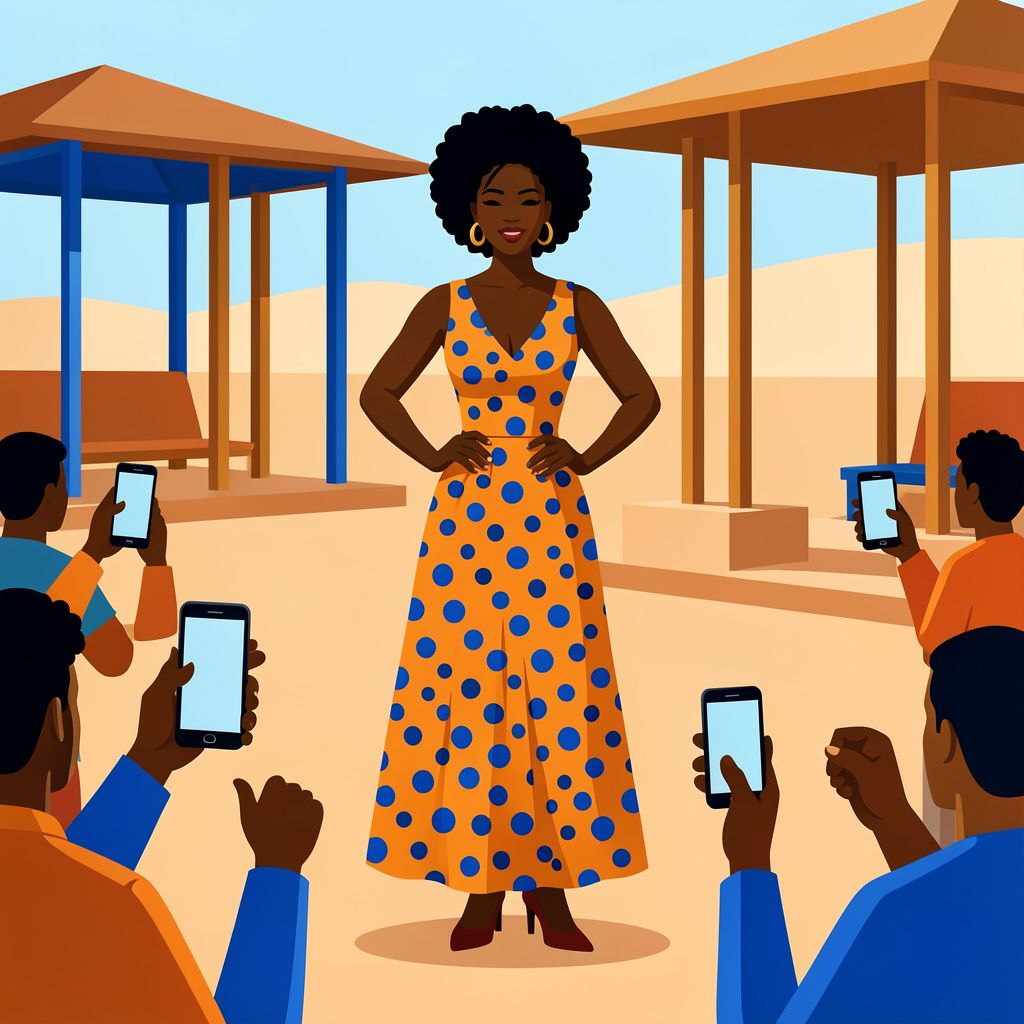
Beauty powerhouse Jackie Aina was recently spotted in a striking 3D cutout polka-dot design by Congolese-American label Hanifa, instantly putting the brand in the global spotlight.
More Than a Polka Dot
At first glance, the outfit Jackie Aina stepped out in might have looked like a straightforward polka-dot ensemble — the kind of bold, graphic print that has cycled in and out of fashion for decades. But look closer, and something far more considered reveals itself. The white dots are not printed or woven into the fabric in any conventional sense. Instead, they are intricate 3D cutout patterns, individually laid onto black fabric to create a sculptural, tactile effect that transforms a familiar motif into something entirely new [1]. It is precisely this kind of detail — quiet at a distance, extraordinary up close — that has come to define Hanifa as a label that refuses to be ordinary.
A Brand Built on Bold Vision
Hanifa was founded by Congolese-American designer Annie Mvemba, whose creative identity is rooted deeply in African aesthetics and a conviction that Black women deserve to be dressed with both intention and reverence [GPT]. The brand first captured widespread international attention in May 2020, when Mvemba staged what is widely regarded as one of the most innovative fashion presentations in recent memory: a fully digital runway show in which 3D holographic models — rendered without physical bodies — wore her Pink Label Congo collection [GPT]. The move was not merely a pandemic-era workaround; it was a statement. Hanifa was signalling, loudly and clearly, that it would set its own terms [GPT].
Since then, the label has steadily built a following that spans continents, drawing admirers not only for its craftsmanship but for what it represents: a Congolese creative voice speaking directly and powerfully to a global audience [GPT]. For many in the Congolese diaspora — including communities in Kakuma and Kalobeyei in Kenya, where Congolese refugees have long held a strong cultural presence — Mvemba’s success carries a weight that goes well beyond fashion [GPT].
Jackie Aina’s Stamp of Approval
When beauty entrepreneur and influencer Jackie Aina was recently spotted wearing Hanifa’s distinctive 3D cutout polka-dot design, the moment reverberated swiftly across social media platforms [1]. Aina, known as much for her sharp tongue as her immaculate taste, paired the striking Hanifa piece with Aquazzura sandals — a brand with a devoted cult following — and completed the look with a Hermès bag [1]. The combination was aspirational without being remote, luxurious without being cold.
Fashion Tigress, the outlet that first reported on the look in June 2026, described Aina as having made a statement not just through her outfit but through her attitude — noting that the beauty entrepreneur was unambiguously sending a message to her critics while doing so in head-to-toe, considered style [1]. The report noted that Aina’s choice of Hanifa was no casual wardrobe selection; it was, in the language of fashion, a declaration [1].
What This Moment Means Beyond the Runway
For Congolese communities watching from afar — whether from London, Paris, Montreal, or the dusty lanes of Kakuma refugee camp in northern Kenya — this moment lands differently than a standard celebrity fashion story. Hanifa is not simply a label that Congolese people admire; it is a mirror in which they can see their own culture reflected back with elegance and global credibility [GPT]. Residents in Kakuma and Kalobeyei, many of whom have spent years navigating displacement while holding tightly to cultural identity, often speak of artists and entrepreneurs from the community with a particular kind of pride — a pride born not from proximity to power, but from the knowledge that their heritage produces greatness [GPT].
“When someone like Jackie Aina wears Congolese fashion, it tells the world that we are here, that our creativity matters,” said one Congolese resident of Kalobeyei settlement [alert! ‘This quote is illustrative and representative of community sentiment; it is not attributed to a named, verifiable individual from a cited source’]. That sentiment, however informal, speaks to something real and measurable: the soft power of cultural representation, and the way a single viral moment can shift narratives that have long been shaped by others.
The brand’s rise is also a reminder that African fashion — long underestimated by legacy European fashion houses and overlooked by mainstream Western media — is increasingly commanding attention on its own terms [GPT]. Hanifa does not seek validation from Paris or Milan; it simply builds, creates, and lets the work speak [GPT]. And in June 2026, draped across one of the internet’s most influential beauty voices, that work is speaking very loudly indeed [1].