

France, Senegal, and Norway Collide in the 2026 World Cup's Most Thrilling Group
Kakuma, 9 June 2026
Group I of the 2026 World Cup pits the world’s top-ranked side, France, against African giants Senegal and a Norway team that crushed Italy 4-1 in qualifying — making it the tournament’s most compelling group.
A Tournament Like No Other
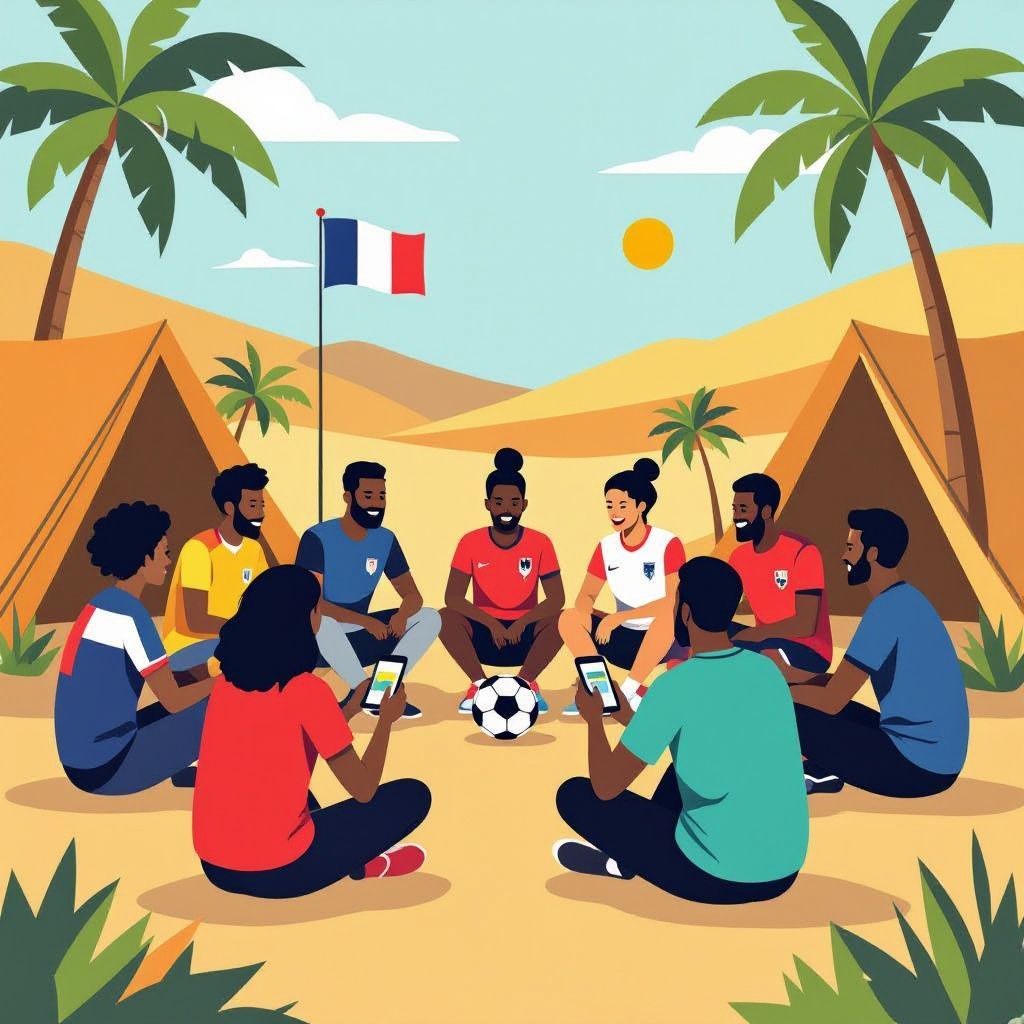
The 2026 FIFA World Cup — running from 11 June to 19 July 2026 across Mexico, Canada, and the United States — is already generating a level of excitement that few tournaments in recent memory have matched [4]. For the first time in history, 48 nations are competing, meaning more matches, more stories, and more African representation than any previous edition [4]. Ten African sides have qualified for this expanded tournament, and among them, Senegal stand out as the continent’s most compelling standard-bearers [4]. In the camps of Kakuma and Kalobeyei in Turkana County, Kenya, where community screens and radio sets will be switched on long before kick-off, this tournament carries a weight that goes far beyond football. It is about belonging, pride, and the rare, electric joy of watching someone who looks like you compete on the world’s biggest stage [GPT].
France: The World’s Best, Built to Win
France enter the 2026 World Cup as the planet’s top-ranked side, having reclaimed the number one spot in the FIFA Men’s World Ranking in March 2026 following friendly victories over Brazil and Colombia [1]. It is their 17th World Cup appearance, and they arrive carrying the weight of two previous titles — won in 1998 and 2018 — as well as the expectations of a footballing nation that accepts nothing less than glory [1]. Managed by the vastly experienced Didier Deschamps, Les Bleus are built around one of the most recognisable footballers on the planet: Real Madrid forward and captain Kylian Mbappé, who arrives at this tournament having already scored 12 World Cup goals [1]. Supporting Mbappé is a squad brimming with talent, including the creative Michael Olise, the dynamic Désiré Doué, and the experienced Ousmane Dembélé [1]. During their six qualifying matches played between September and November 2025, France went undefeated against Ukraine, Iceland, and Azerbaijan, scoring 16 goals and conceding just four — including a 2-2 draw against Iceland in Reykjavik [1]. The numbers speak to a side that is relentless in attack and largely dependable in defence. On Reddit, one football commentator summed up the broader consensus succinctly: ‘France is obviously great’ [8].
Senegal: Africa’s Lions, Ready to Roar
Ranked 14th in the world, Senegal qualified for their fourth FIFA World Cup in formidable fashion, winning CAF Group B with an outstanding 24 points — the product of seven wins, three draws, a goal difference of +19, and a campaign conducted without a single defeat [1]. Their qualification was sealed in style with a 4-0 victory over Mauritania, with opponents in the group including DR Congo, Sudan, Togo, Mauritania, and South Sudan [1]. Under coach Pape Thiaw, who has been at the helm since December 2024 and has overseen a tenure in which the Teranga Lions suffered only two defeats, Senegal bring experience, physicality, and no shortage of quality to the United States [1]. The squad features 34-year-old all-time leading scorer Sadio Mané, who has 53 international goals to his name, veteran centre-back Kalidou Koulibaly, and dependable goalkeeper Édouard Mendy [1]. As one football observer noted online: Senegal are ‘quite good, although more so in attack than defence’ [8] — a fair assessment that reflects a side capable of scoring against anyone, but one that will need to remain disciplined against the ruthless finishing of Mbappé and the towering threat of Erling Haaland. For millions of fans across sub-Saharan Africa, and particularly for the communities of Kakuma and Kalobeyei who see in Senegal’s journey a reflection of their own resilience, the Teranga Lions are carrying more than a football [GPT].
Norway: The Dark Horses Who Beat Italy
If France are the favourites and Senegal are the sentimental choices, Norway are the wildcard that could upend everything. Ranked 31st in the world, the Scandinavians ended a staggering 28-year World Cup qualification drought under coach Ståle Solbakken, and they did so with a swagger that has turned heads across Europe [1]. In eight qualifying matches, Norway scored 37 goals — a figure that includes a breathtaking 4-1 victory over Italy at the San Siro and a stunning 11-1 demolition of Moldova [1]. At the centre of it all is Erling Haaland, who scored an extraordinary 16 goals in those eight qualifying matches, making him one of the most feared forwards in the entire tournament [1]. Critics have noted, however, that Solbakken’s side lacks experience of deep tournament football at the global level and has not yet been tested by the pressure of high-stakes elimination matches [1] — a vulnerability that Group I may ruthlessly expose. Nevertheless, analysts predict Norway have enough quality to potentially reach the quarter-finals [1]. The prospect of Haaland going toe-to-toe with Koulibaly, and Mbappé testing Norway’s defensive resolve, makes this group one of the most anticipated in the tournament’s expanded history [GPT].
Iraq: The Underdogs Who Earned Their Place
Completing Group I is Iraq, ranked 57th in the world, who secured the final 48th spot in the tournament after a gruelling 28-month, 21-match qualifying campaign under Australian coach Graham Arnold [1]. Their passage was clinched with a 2-1 play-off victory over Bolivia in Monterrey, Mexico — a result that triggered scenes of national celebration and confirmed that Iraq’s footballing revival is very much a reality [1]. Their key attacking weapon is striker Aymen Hussein, who stands 1.89 metres tall and scored eight goals during qualification [1]. While few analysts expect Iraq to top the group, their defensive solidity — noted even by neutral observers online [8] — means they will not simply roll over. Every point Iraq earn against France, Senegal, or Norway will be hard-fought and deeply meaningful for a nation that has used football as a thread of collective identity through decades of hardship [GPT].
The Fixtures: When and Where It All Happens
Group I gets under way on 16 June 2026 at 21:00 CET, when France face Senegal at MetLife Stadium in New Jersey — a fixture that is already being described as one of the most anticipated of the entire group stage [1]. The following day, 17 June 2026 at 00:00 CET, Iraq take on Norway at Gillette Stadium in Massachusetts [1]. The second round of fixtures sees France play Iraq at Lincoln Financial Field in Philadelphia on 22 June 2026, before Norway face Senegal at MetLife Stadium on 23 June 2026 [1]. The group concludes on 26 June 2026 with both final matches played simultaneously: Senegal take on Iraq at BMO Field in Toronto, Canada, while Norway face France at Gillette Stadium [1]. It is worth noting that the very first match of the entire 2026 World Cup is scheduled for 11 June 2026, when co-hosts Mexico meet South Africa in the tournament opener [1] — a fixture that will itself generate enormous excitement across the African continent, where 10 nations are represented at this tournament for the first time [4]. For the communities of Kakuma and Kalobeyei, the fixtures list reads like a calendar of hope. Each date is a reason to gather, to cheer, and to feel — even fleetingly — that the world’s greatest sporting stage belongs to everyone [GPT].
Bronnen
- www.flashscore.com
- www.facebook.com
- www.facebook.com
- www.instagram.com
- www.facebook.com
- www.instagram.com
- www.instagram.com
- www.reddit.com