

Africa's Best Referee Barred from World Cup After 11-Hour US Immigration Interrogation
Mogadishu, 9 June 2026
Somalia’s Omar Artan, named Africa’s top referee in 2025, was denied entry to the United States on 6 June 2026 despite holding a valid visa and diplomatic passport, ending his historic bid to become the first Somali to officiate at a World Cup finals.
A Dream Eight Years in the Making
For Omar Abdulkadir Artan, the road to the 2026 FIFA World Cup was paved with years of quiet, relentless dedication. The 34-year-old from Somalia first earned his FIFA referee badge in 2018 [1][3], and in the years that followed, he built a reputation that would carry him to the very summit of the officiating world. In November 2025, the Confederation of African Football (CAF) named him the continent’s best male referee [1][3][6], a recognition that cemented his standing as one of the most respected officials on the African continent. Then, in April 2026, came the announcement that changed everything: Artan had been selected as one of just 52 referees chosen from across the globe to officiate at the 2026 World Cup finals, co-hosted by the United States, Canada, and Mexico [1][6]. He would be the first Somali ever to take to the pitch at a World Cup finals [1][2][4]. Somalia’s President Hassan Sheikh Mohamud offered his personal congratulations [6], and Artan himself, speaking to BBC Somali during the week of 1 June 2026, captured the magnitude of the moment in simple, powerful terms: “When you are selected, you feel that all your hard work was worth it. It was a moment where everything came into focus. Years of effort finally made sense.” [1]
Eleven Hours at the Border
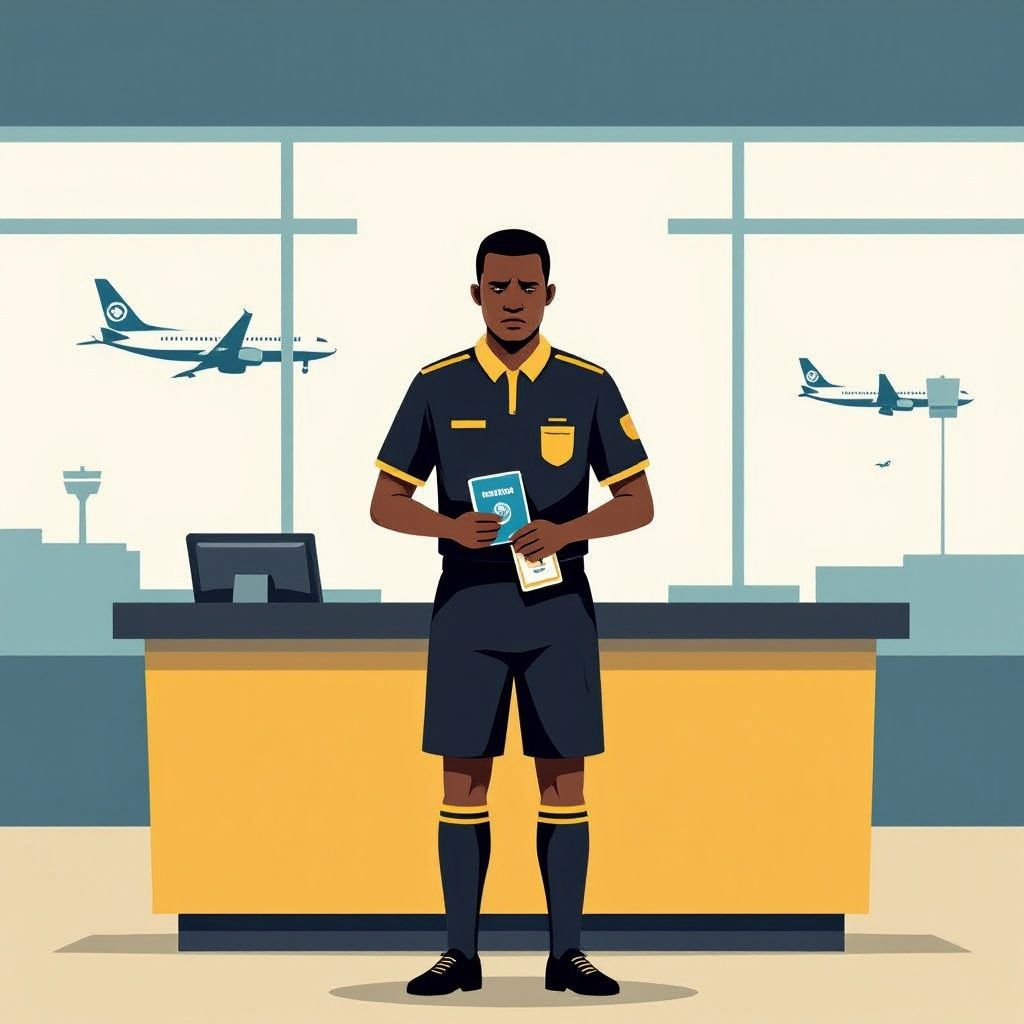
The dream was shattered on Saturday, 6 June 2026, at Miami International Airport. Artan, travelling with a valid single-entry US visa and a diplomatic passport [1][3], was detained by Customs and Border Protection (CBP) officers upon his arrival [6]. What followed was an 11-hour interrogation that reportedly touched on concerns related to the militant group al-Shabab [3], before border officials invoked what they described as “vetting concerns” and denied him entry [1][6]. He was turned back to Istanbul, Turkey, where he remained as of Tuesday, 9 June 2026, with plans to fly home to Mogadishu, Somalia, on Wednesday, 10 June 2026 [1][3]. The Somali Football Federation (SFF) immediately contacted FIFA seeking urgent clarification [3]. By Monday, 8 June 2026, FIFA had issued a statement that left little room for hope: “Fifa is not involved in host country immigration processes, including visa adjudications, and has been informed by authorities that Mr Artan’s status will not be changed at present. A host government ultimately determines who receives a visa and who is admitted into their country.” [1][3] The governing body confirmed it was unable to intervene [1][3], and Artan was formally dropped from the list of World Cup officials [3].
A Structural Barrier, Not Just a Bureaucratic One
What made Artan’s exclusion particularly final was a logistical decision taken long before his name was ever stamped in a passport. FIFA’s referees’ chief Pierluigi Collina had established a mandatory training hub in Miami, Florida, for all 52 referees and 88 assistant referees appointed to the tournament [3]. Because all on-pitch officials are required to complete that training programme, there was no possibility of reassigning Artan to matches held exclusively in Canada or Mexico — the two co-host nations where US immigration restrictions would not apply [1][3]. The consequence was absolute: with no Miami training, there could be no World Cup. Africa’s representation among the officiating panel will now be drawn from six referees hailing from Algeria, Egypt, Gabon, Mauritania, Morocco, and South Africa [1]. The World Cup itself is scheduled to run from 11 June to 19 July 2026 [3][6], meaning Artan’s absence will be felt from the very first whistle. Andrew Giuliani, leader of the White House Task Force on the World Cup, offered only a brief and opaque defence of the decision: “While I can’t go into the derog [derogatory information] on that I can tell you it was the right decision by customs and border patrol and I support that decision.” [3]
A Pattern That Goes Beyond One Man
Artan’s case did not emerge in isolation. In the lead-up to the tournament, more than 120 civil organisations issued a joint travel advisory warning non-citizens to exercise caution when travelling to the United States [6]. On Friday, 5 June 2026 — just one day before Artan’s own detention — two members of Iraq’s World Cup delegation faced entry difficulties at Chicago O’Hare International Airport: striker Aymen Hussein was held for seven hours before eventually being permitted entry, whilst team photographer Talal Salah was denied entry entirely and returned home, also on grounds of “vetting concerns” [6]. These incidents are taking place against the backdrop of the Trump Administration’s revived travel ban, which covers 39 countries, including Somalia, and which was reinstated in 2025 — though exemptions were made available for World Cup athletes and support staff [6]. The broader picture prompted former England striker and pundit Ian Wright to speak out bluntly: “Every few hours, it’s another story about fans denied, player denied, officials denied, journalists denied, now refs. I’m laughing but it’s not funny. It’s actually not funny and something has to be said… Is this the spirit of football, really?” [3] US women’s international and professional footballer Sydney Leroux added her voice on 8 June 2026, writing on Instagram to her audience of over 61,000 likes and 980 comments: “The World Cup is supposed to bring the world together and not remind us of the lines that divide us because football is and always will be, for everyone.” [4]
Grace in the Face of Injustice
What has struck many observers in the days since 6 June 2026 is the quiet dignity with which Artan himself has responded. A senior adviser to Somalia’s Ministry of Youth and Sports, Ciise Aden Abshir, described him as “among Africa’s most respected referees” who “deserves the support of the entire football community” [6]. President Hassan Sheikh Mohamud stated: “I commend the effort, professionalism, and integrity shown by referee Omar, as he has become a symbol of inspiration for the new generation of Somalis” [1][6]. Artan, for his part, released a statement that carried more sportsmanship than the circumstances arguably deserved: “I would like to thank Fifa and Caf for all their support and I promise to keep my refereeing levels up as I concentrate on the future. I want to thank the football family for their messages and wish my colleagues all the best success during the World Cup and I look forward to joining them again in future competitions.” [1][3][6] Earlier, in his BBC Somali interview during the week of 1 June 2026, he had spoken of what drives him: “You cannot give up as a referee. You have to continue, and you have to fight if you want to go to a place like the World Cup.” [6] For the large Somali communities in Kakuma, Kalobeyei, and around the world, those words now carry a particular weight — not as the preamble to a triumph, but as a testament to a journey that was robbed of its destination at the very last step. The 2026 World Cup kicks off on 11 June 2026 [3][6]. Omar Artan will not be there. But the conversation his exclusion has ignited about the intersection of sport, politics, and human dignity shows no sign of being silenced.