

Kenya Brings Digital Health Registration to Remote Turkana Through Fingerprint Technology
Lodwar, 9 June 2026
Turkana County has deployed biometric devices across 167 health facilities, replacing easily shared one-time passwords with fingerprint authentication to secure Kenya’s new national health insurance scheme, Taifa Care.
What Has Changed and Why It Matters
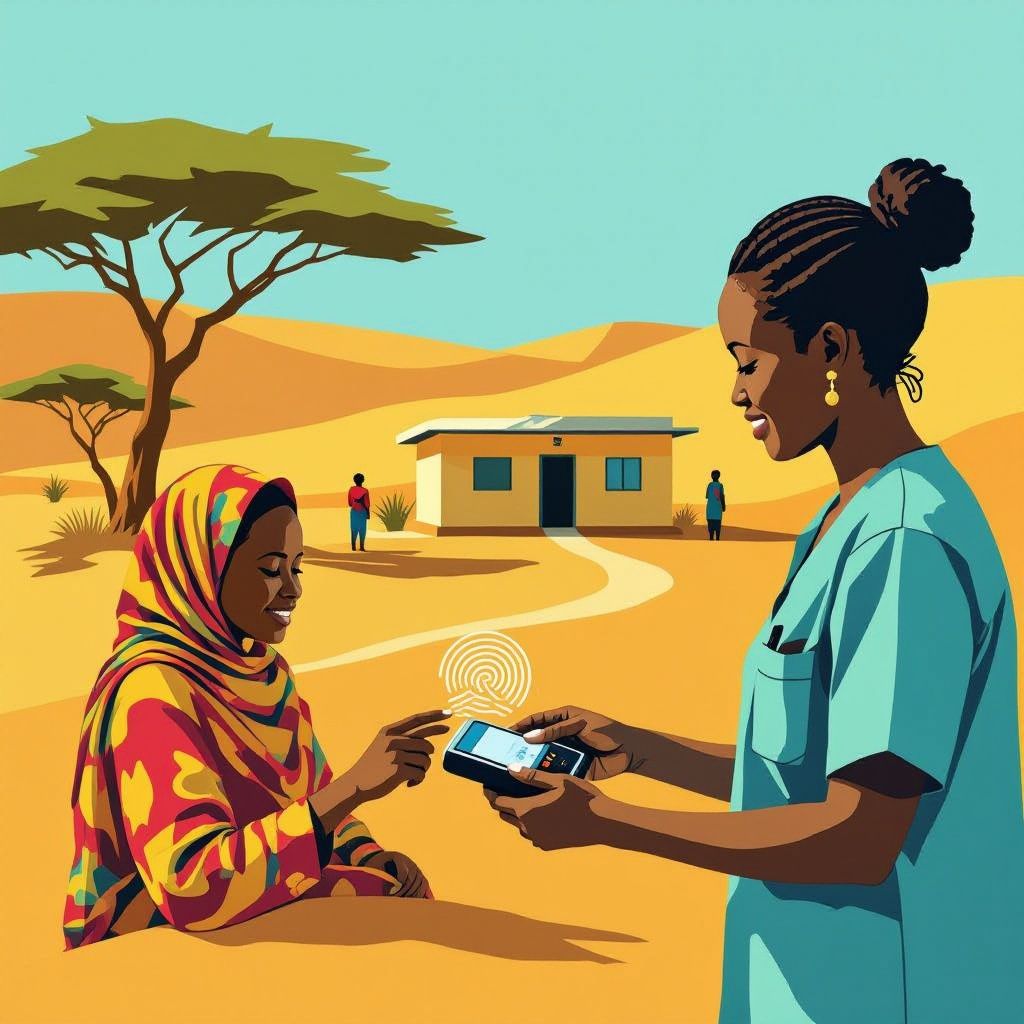
On 8 June 2026, Turkana County’s Department of Health and Sanitation Services announced that it had received biometric registration and authentication devices for 167 Level II health facilities, covering all 11 sub-counties of the county [1]. The rollout is a direct response to a known weakness in the previous system: health facilities had been relying on One-Time Passwords (OTPs) to verify patients seeking services, a method that proved easy to share, misuse, or abuse [1]. Under the new arrangement, a patient’s fingerprints are linked directly to their health identification records, which means that only the registered person can access services — not a family member using a borrowed code, and not a fraudster using a stolen one [1]. The Chief Officer for Medical Services, Dr. Gilchrist Lokoel, explained the significance plainly: ‘The technology will help reduce fraud by ensuring healthcare funds are utilized only by genuine beneficiaries, thereby safeguarding the integrity and sustainability of Taifa Care’ [1]. This upgrade arrives at a critical moment. Nationally, the Social Health Authority (SHA) — the body overseeing Taifa Care — has already registered over 30 million Kenyans to access free primary healthcare [2]. Securing that system against misuse is now a top priority.
Understanding Taifa Care: Kenya’s New National Health Scheme
Taifa Care is Kenya’s national health insurance scheme, which replaced the former National Hospital Insurance Fund (NHIF) [GPT]. It is administered by the Social Health Authority (SHA), established under the Social Health Insurance Act, 2023 [2]. The scheme is central to the Kenyan Government’s Universal Health Coverage (UHC) agenda, part of the broader Bottom-Up Economic Transformation Agenda (BETA) [2]. Under Taifa Care, young women can access free maternal healthcare, and registered members are entitled to free primary healthcare at enrolled facilities [2]. For Turkana residents — a county covering 77,000 square kilometres and located in the north-western corner of Kenya — the previous barriers to accessing formal health insurance were considerable [1]. Distance, limited infrastructure, and cumbersome registration processes all worked against uptake. The biometric rollout, supported by the Digital Health Agency (DHA) and Safaricom PLC, is designed specifically to reduce those barriers by making registration and authentication faster, more secure, and less dependent on paperwork [1].
How to Register and Access Services: A Step-by-Step Guide
For Turkana residents wishing to access services through Taifa Care at one of the 167 newly equipped Level II facilities, the process is now more straightforward than before [1]. First, residents must be registered under the SHA. Registration can be done at the health facility itself, where biometric devices are now available to capture fingerprints and link them to a health identity record [1]. The County ICT Officer at the Department of Health, Eliud Eyangan, confirmed that the devices are intended to ‘strengthen digital health systems and improve patient experience in the effective implementation of Taifa Care’ [1]. Once registered, a patient visits their nearest Level II facility. Instead of receiving or entering a One-Time Password, they simply use their fingerprint to authenticate their identity at the point of service [1]. This eliminates the need to remember codes, carry documents, or wait for OTP messages — a meaningful advantage in areas with unreliable mobile connectivity. According to Dr. Lokoel, the system will also ‘reduce paperwork and minimize manual data-entry errors, significantly reducing waiting times for beneficiaries during registration’ [1]. For those in and around Kakuma and Kalobeyei, including members of the host community, the same process applies at enrolled facilities [alert! ‘The source confirms host community inclusion broadly but does not specify which individual facilities near Kakuma or Kalobeyei are enrolled’]. Refugees holding valid documentation and registered under SHA-linked schemes should follow guidance from their camp health partners — such as the IRC and MSF — to understand how their existing health service arrangements interact with the Taifa Care rollout [alert! ‘No source directly confirms IRC or MSF guidance on this specific transition; this is drawn from the user brief and should be verified with camp health partners’].
Broader Context: Digital Health Across Kenya
The Turkana deployment is part of a wider national push to use technology to strengthen health systems. On 8 June 2026, Kenya’s Health Principal Secretary, Dr. Ouma Oluga, met with the Africa Centres for Disease Control and Prevention (Africa CDC) Mission to discuss the African Pooled Procurement Mechanism (APPM), which is designed to complement Kenya’s ongoing health reforms, specifically targeting health financing, commodity security, and digital health systems [2]. Separately, Kiambu County completed its first telemedicine-assisted surgery — a live Caesarean section — using the Proximie digital platform [2], demonstrating just how rapidly Kenya’s health technology landscape is evolving. The Kenya National Public Health Institute (KNPHI) also conducted a week-long Ebola preparedness training programme for Rapid Response Teams in both Trans Nzoia and Turkana counties, supported by the United States-funded Strengthening Infectious Disease Detection Systems (STRIDES) programme [2], underlining that Turkana is receiving attention from multiple angles of health system strengthening simultaneously. Taken together, these developments suggest that the biometric rollout in Turkana is not an isolated initiative but one thread in a much larger fabric of health system reform. The Turkana County Government stated plainly that it ‘remains committed to delivering accessible, quality, and accountable healthcare services to all residents’ [1] — and as of 8 June 2026, that commitment has taken a concrete, verifiable form in the shape of 167 fingerprint readers distributed across one of Kenya’s most geographically challenging counties.