

A Rising Lake Is Tearing Apart Communities in Northern Kenya — and the Danger Is Growing
Turkana, 4 June 2026
Lake Turkana’s expanding waters have turned villages into islands, sparked crocodile attacks, and ignited armed ethnic clashes as desperate herders compete with traditional fishermen for vanishing catches.
A Village Swallowed by the Lake
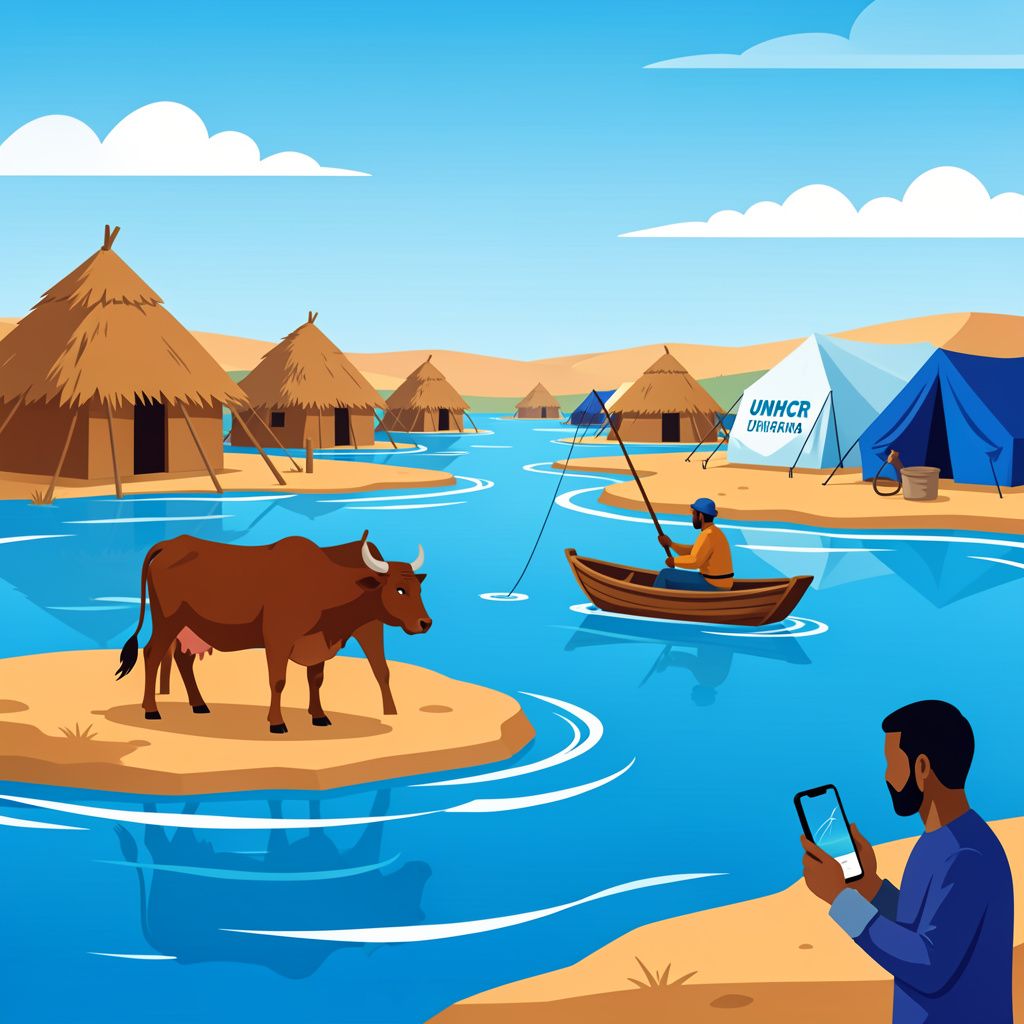
On Komote Island, off the shore of Lake Turkana in northern Kenya, the transformation of the landscape over the past decade tells a story that no climate report could fully capture. Alfred Lenkutuk, a 71-year-old member of the El Molo people — one of Africa’s smallest and most marginalised indigenous groups — sits in his hut and recalls a time when his village was not an island at all [1]. As recently as ten years ago, the community where he was born sat firmly on the mainland. Today, it is separated from the shore by approximately 660 yards of water, with residents relying on homemade rafts and small boats to reach the rest of Kenya [1].
From Abundance to Scarcity: The Collapse of a Fishing Way of Life
The material decline experienced by lakeside communities is stark when measured in the most basic unit of survival: food. Lenkutuk recalls communal hippo hunts along the lakeshore in his youth, and fishermen returning with catches exceeding 250 pounds. Today, hippos have been virtually wiped out from the area, and a catch of even 10 pounds of fish is considered fortunate [1]. This collapse in catches is not simply the result of rising water levels. Lake Turkana is the world’s largest permanent desert lake, and its waters have long sustained hundreds of thousands of people across one of the most isolated and neglected regions of Kenya [1]. What has changed is the convergence of multiple simultaneous pressures: rising water levels attributed to a combination of climatic and tectonic factors, persistent drought across northern Kenya, and a dramatic increase in the number of people competing for a shrinking resource [1].
Armed Clashes and Crocodile Attacks: A Dual Threat on the Water
The consequences of this intensifying competition have moved well beyond economic hardship. Inter-ethnic conflict has been rising sharply across the lake’s fishing communities, with gun battles between fishermen on the water now described as a regular occurrence as of mid-2026 [2]. The disputes centre on access to fishing grounds — territories that have themselves been shifting and contested as the lake’s boundaries continue to move. Longstanding ethnic tensions between communities, which have historically flared over land and water rights in Turkana West, are being reignited by the immediacy of survival competition [1][2]. For island communities such as those on Komote, the threat is two-directional: violence from rival fishermen on the water, and attacks from crocodiles whose own habitat and behaviour have been disrupted by the changing lake levels [1].
What This Means for Refugees in Kakuma and Kalobeyei
The Kakuma refugee camp and the adjacent Kalobeyei Integrated Settlement are home to one of East Africa’s largest refugee populations, and they sit squarely within the broader Turkana West region where these environmental and security pressures are unfolding [GPT]. The host Turkana community’s livelihoods are under severe and worsening strain — a fact that carries direct implications for refugees. When host communities face acute resource competition and rising insecurity, the social contract that underpins coexistence between refugees and hosts comes under pressure [GPT]. Access to local fish markets, which can form part of the informal food economy for both host and refugee populations, is increasingly unreliable as catches decline and conflict disrupts supply chains [1][2].