

Deadly Clashes Spark Mass Displacement to the Kenyan Border
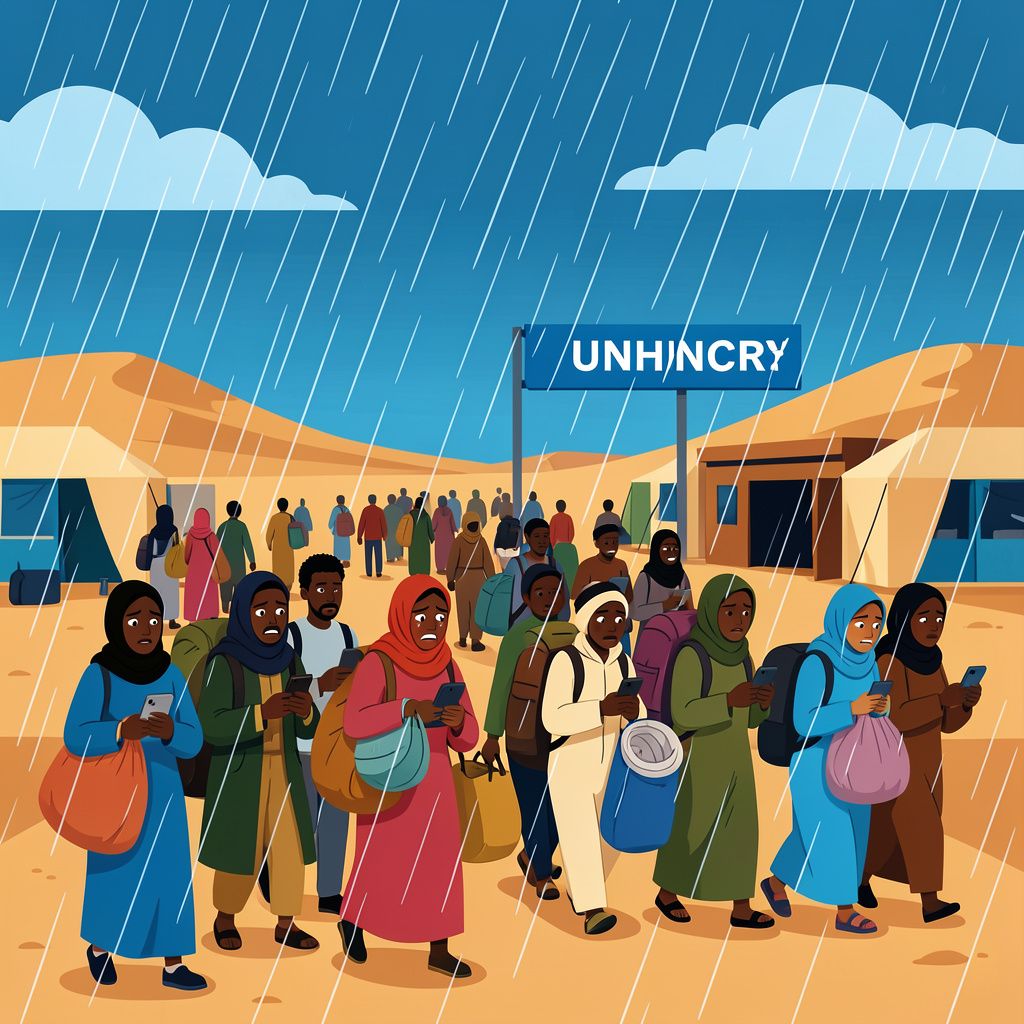
Moyale, 27 October 2026
Renewed violence in Moyale has forced up to 40,000 Ethiopians across the border, triggering an urgent humanitarian crisis intensified by heavy seasonal rains and strained local emergency resources.
Escalation in Moyale and the Surge in Border Crossings
The border town of Moyale, positioned on the boundary between Ethiopia’s Oromia and Somali regions, descended into severe armed conflict following tensions linked to a regional flag [1][4]. The clashes escalated sharply after a 13-year-old girl, identified as Diko Jatan Agha, was killed during an exchange of gunfire on 18 October 2026 (Tikimt 8, 2019 E.C.) [1][6]. Armed exchanges between regional security elements subsequently engulfed local civilian neighbourhoods, spreading outwards to seven districts across southern Oromia and severely disrupting regional transport corridors [1]. Local infrastructure sustained significant destruction, including burnt residential properties, severe damage to the TVET Centre in the Jamuq quarter, and fire damage to Kalmo Shidal Secondary School [1][4].
Mounting Influx and Strained Reception Realities
The acute security breakdown prompted a rapid surge of civilians fleeing across the international boundary into Kenya. While early displacement reports placed cross-border entries past 10,000 [6] and 14,000 individuals [2], the United Nations High Commissioner for Refugees (UNHCR) confirmed that approximately 36,000 Ethiopian asylum seekers have arrived in Kenya seeking safety [1]. Expanding on these figures, the Kenya National Commission on Human Rights (KNCHR) reported that the total number seeking shelter in Moyale reached upwards of 40,000 people [1]. The demographic distribution of the displaced highlights that the majority are women and children, with more than 15,000 sheltering across eight temporary reception sites and over 20,000 accommodated directly by local host communities and relatives [1].
Humanitarian Supply Pressures and Compounding Health Risks
Emergency logistics in Moyale face mounting logistical bottlenecks as regional rainfall compounds local vulnerabilities. The KNCHR noted that ongoing seasonal precipitation threatens to degrade sanitation infrastructure and increase the outbreak risk of communicable diseases [1]. Compounding these concerns, displaced families arriving at reception sites such as Gambo face acute shortages of clean drinking water, electricity, and basic relief commodities [1][4]. Out of the roughly 40,000 people recorded by the human rights commission, the proportion settled across the eight formal temporary sites represents 37.5% of the displaced population, leaving 50% reliant entirely on informal support networks [1]. Healthcare systems are additionally strained by specialized demands, with four women having given birth across two border sites, triggering heightened calls for emergency maternal and reproductive medical interventions [1].
Coordinated Emergency Relief and Cross-Border Protection
In response to the widening reception deficit, an international humanitarian coalition comprising UNHCR, the International Organization for Migration (IOM), UNICEF, the World Food Programme (WFP), and the Kenya Red Cross Society has mobilised operational relief in conjunction with Kenyan authorities [1]. Beyond basic provisions of food, water, and weather-resistant shelter materials, protection observers have urged security agencies on both sides of the frontier to maintain non-discriminatory, proportionate, and lawful protocols [1]. Observers also note that the influx arrives amid heightened regional public health monitoring following reported Ebola fatalities in Nairobi [2][4]. For border administrators, the relative calm now observed across crossing points offers an indispensable operational window to stabilise humanitarian transit corridors, manage resource flows, and protect both asylum seekers and hosting communities [1].
Bronnen
- addisstandard.com
- www.facebook.com
- youtu.be
- www.facebook.com
- wolaitatimes.com
- www.facebook.com
- www.facebook.com