

Kakuma to Get Its First Fire Station, Ending Reliance on a Fire Engine Over 120 Kilometres Away
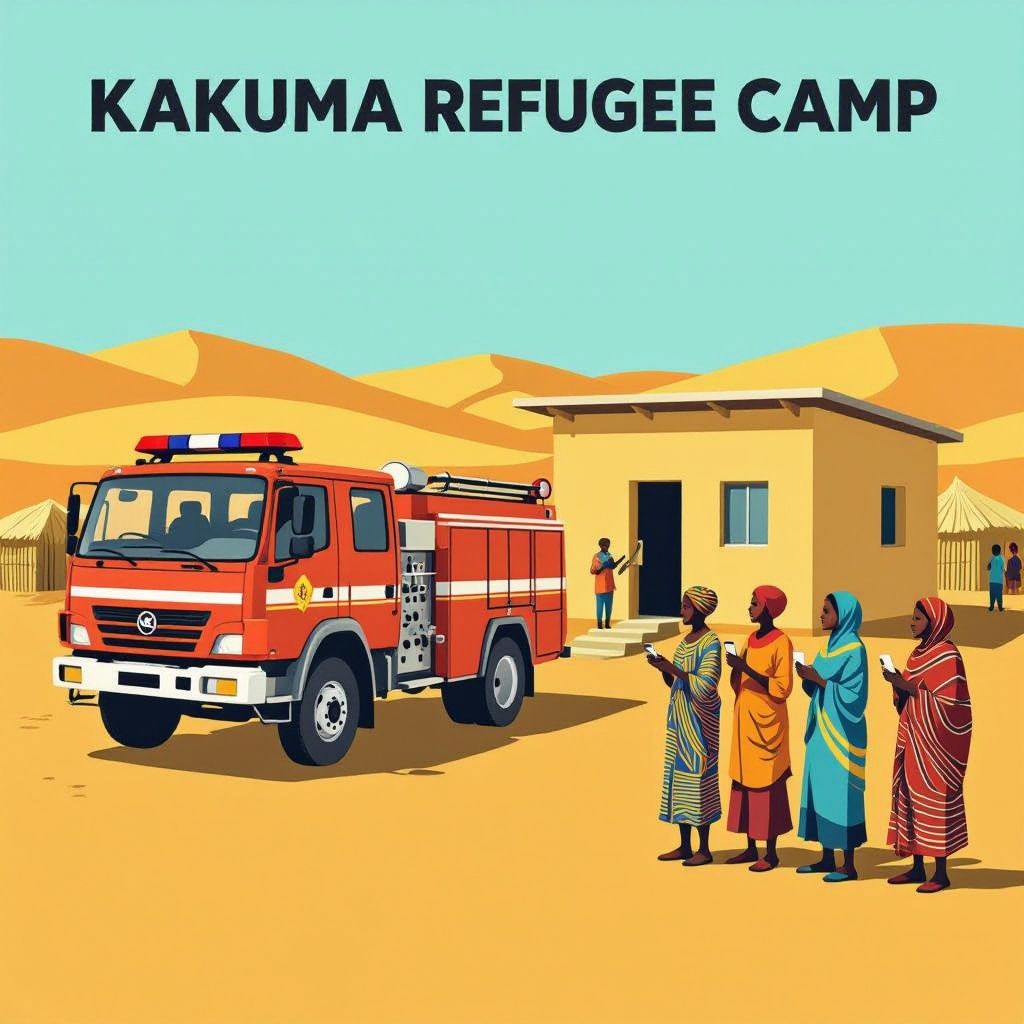
Kakuma, 12 June 2026
A densely populated area hosting one of East Africa’s largest refugee communities has never had a fire station — until now. World Bank funding is set to change that.
A Gap That Has Long Defined the Risk
For a municipality that is home to one of East Africa’s largest concentrations of refugees and host-community residents, the absence of a fire station has not merely been an inconvenience — it has been a measurable public safety crisis. As of June 2026, Kakuma Municipality has no fire station of its own [1]. When a fire breaks out, the nearest response comes from Lodwar, the county seat of Turkana County, situated more than 120 kilometres away [1]. That single fire engine and its crew stationed in Lodwar represent the entirety of formal fire cover for a densely populated urban area that a recent assessment by the County Fire Unit has determined to be highly vulnerable to fire outbreaks [1]. The distance alone — 120 kilometres of road across one of Kenya’s most arid and remote regions — makes any meaningful emergency response within the critical first minutes of a fire virtually impossible [1][GPT].
The Announcement: World Bank Funding to Deliver Kakuma’s First Station
That long-standing gap is now set to close. On 10 June 2026, the Turkana County Government announced that Kakuma Municipality is to receive its first ever fire station, with a site identified at Nakoyo Village [1][2]. The project is funded under the Kenya Urban Support Programme Phase II (KUSP II), a World Bank-funded initiative, and falls within the 2025–2026 financial year budget [1]. The site inspection, which took place on 10 June 2026, was led by Municipality Manager Eng. Benjamin Tukei and brought together representatives from UN-Habitat, the Kakuma Municipal Board, surveyors, engineers, officers from the Environment Social Safeguards team, and personnel from the fire brigade [1][2]. The involvement of UN-Habitat alongside the County Government signals that this is not a routine local infrastructure project — it is a deliberate intervention in a complex urban environment where formal public services have historically lagged far behind the scale of need [2].
Serving Both Sides of the Wire: Host Community and Refugees Together
What makes this development particularly significant is who it is designed to serve. The proposed fire station at Nakoyo Village is explicitly intended to benefit both the host community and the refugee population living in and around Kakuma [1][2]. This shared-infrastructure approach reflects a broader shift in how humanitarian and development actors are thinking about service delivery in refugee-hosting areas — moving away from parallel systems and towards integrated public infrastructure that serves everyone within a given municipality [GPT]. Nakoyo Land Committee Chair David Lojore, who was present at the site inspection on 10 June 2026, welcomed the project and expressed hope that the facility would also bring electricity and other social amenities to the area [1]. Lojore further noted that the station should be capable of serving the wider Turkana West sub-county, including the towns of Lokichoggio, Nanam, and Letea [1] — communities that currently have no fire cover whatsoever.
Turkana West: Scale, Remoteness, and the Infrastructure Challenge
Understanding the significance of this project requires an appreciation of the geography involved. Turkana County is the second largest county in Kenya by area, covering 77,000 square kilometres [1]. It is also the north-western most county in the country, bordering South Sudan, Ethiopia, and Uganda [1][GPT]. Kakuma Municipality sits within this vast and remote expanse, and the refugee camp and settlement it hosts rank among the largest in East Africa [GPT]. Infrastructure in the region has historically been sparse, and the absence of a fire station is symptomatic of a wider pattern of underinvestment in formal public services for what has long been treated primarily as a humanitarian caseload rather than an urban population [GPT]. David Kitenge from UN-Habitat, who was present at the 10 June 2026 site inspection, confirmed the agency’s ongoing commitment to delivering key infrastructure alongside the Municipality [1]. Eng. Tukei, in his remarks at the inspection, was direct about the operational change the station will bring: the Municipality will finally have the capacity to respond to fire outbreaks locally, rather than depending on Lodwar [1]. The land acquisition process and further community engagements are expected to follow in the coming weeks [alert! ‘No specific timeline for construction start or completion has been confirmed in the available sources’], with due process to be observed throughout [2].