

Kenya's President Personally Approved a US Ebola Quarantine Facility — and Not Everyone Is Happy About It
Nanyuki, 2 June 2026
President Ruto’s admission that he personally greenlit a US-backed Ebola quarantine centre at Laikipia Air Base has sparked street protests, a High Court suspension, and a sharp national debate — all while Kenya has recorded zero Ebola cases.
From Cautious Approval to Public Admission
This story has moved quickly. When it first broke, Kenya had signalled cautious approval of a US-backed plan to quarantine American citizens exposed to Ebola on Kenyan soil — a significant policy shift from the previous practice of repatriating such patients to the United States. For the full background, including details of the Congo outbreak that triggered the plan, see our earlier report: US Plans Ebola Quarantine Facility in Kenya as Congo Outbreak Surpasses 1,000 Cases. Since that report, the story has escalated sharply. President William Ruto has now gone on record to confirm that he personally authorised the facility, street protests have erupted in Nanyuki, and Kenya’s High Court has intervened [1][3].
‘I Gave the Okay’ — Ruto Speaks Plainly
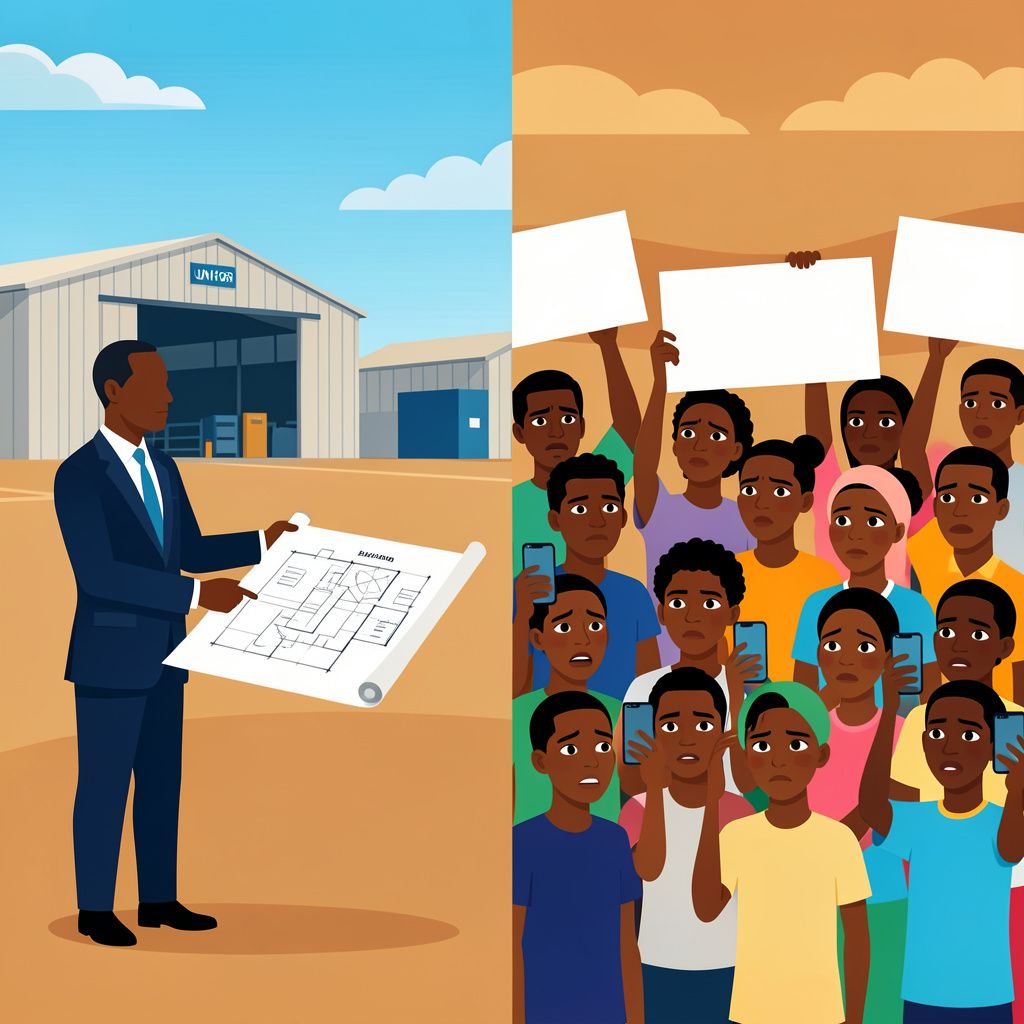
Speaking during a media roundtable at Wajir State Lodge on 31 May 2026, President Ruto left no ambiguity about his role in approving the facility [1]. ‘When President Trump asked the government of Kenya to support them by having a centre at Laikipia Air Base, I gave the okay because it was an agreement and a partnership with friends who have worked with Kenya for 30 or 40 years. The American government has supported us,’ Ruto stated [1][4]. The President framed the decision as one rooted in long-standing bilateral ties and mutual health security interests, not as a concession to external pressure [1]. He further defended the broader public health architecture underpinning the decision: ‘We have deployed every arsenal that we have to make sure that we protect Kenya, that we deal with the challenge. We have made preparations for isolation units, for surveillance, for treatment’ [1].
A Network of 23 Facilities — Not a Standalone Deal
A key element of Ruto’s defence is that the Laikipia Air Base facility does not exist in isolation. It is one of 23 disease preparedness centres established across Kenya [1][5]. Other designated sites include Kenyatta National Hospital in Nairobi, the National Police Service Hospital in Nairobi, Moi Teaching and Referral Hospital in Eldoret, Kenyatta University Teaching, Referral and Research Hospital on the Nairobi-Kiambu border, and Alupe Hospital in Busia [1]. On 1 June 2026, the President reiterated that these health centres are intended solely to support screening, isolation, and treatment in the event of an outbreak, and urged leaders not to politicise public health preparedness, describing it as critical to national security and public safety [1]. Kenya is currently screening an average of 3,000 visitors daily at all entry points, and as of the time of writing, zero Ebola cases have been recorded in the country [1]. Health Minister Aden Duale added further nuance on Sunday 1 June 2026, stating that the quarantine centre was intended for ‘everyone’ and was not exclusively for US nationals [3].
Protests on the Streets of Nanyuki
Not everyone has been persuaded. On Monday 1 June 2026, hundreds of youths marched to the gates of Laikipia Air Base in the central Kenyan town of Nanyuki, chanting anti-Ebola slogans in direct opposition to the facility [3][6]. The protest drew significant national attention, with footage circulating widely on social media [6]. Laikipia Governor Joshua Irungu was among those voicing concern, telling journalists he was opposed to the facility and warning that many local residents work inside the air base and could be exposed to the virus [3]. Local resident Malin Ndegwa put the community’s frustration plainly: ‘Why are they not doing it in the DRC? Why are they not doing it in Uganda? Why must they bring it here? So we are saying, categorically, no negotiations, no public participation, we want nothing. We want that facility taken out of our town, we want it taken out of Kenya’ [3]. The protests came just two days after Kenya’s High Court suspended the establishment of the facility and the arrival of any foreign patients, pending the hearing of a case filed by the Law Society of Kenya and a constitutional watchdog [3]. The two organisations cited Kenya’s fragile health system as the central reason why foreign Ebola patients should not be quarantined in the country [3].
The Outbreak Context and the US Financial Commitment
The quarantine facility is a direct response to an active and serious outbreak. At least 282 confirmed cases of the Bundibugyo strain of Ebola have been reported in the Democratic Republic of Congo, with over 1,000 suspected cases in total [3]. The Bundibugyo virus currently has no approved treatment or vaccine [3]. Kenya’s neighbour Uganda has reported nine cases and has closed its border with Congo [3]. It was US officials who first disclosed the Kenya facility plan on Thursday 29 May 2026, speaking on condition of anonymity; they said the facility would be operational with 50 quarantine beds by Friday 30 May 2026 [3]. To underline the financial weight of the commitment, US Secretary of State Marco Rubio confirmed that the US government intends to commit $13.5 million towards Kenya’s Ebola preparedness efforts [3]. Ruto, for his part, refused to allow political opposition to reframe what he described as a sound public health decision: ‘I am wondering why anybody would want to politicise a matter so serious as a pandemic. We are a responsible government, and we know what we are doing’ [1][4].
What This Means for Refugees and Camp Communities
For residents of Kakuma and Kalobeyei, the developments in Nanyuki carry direct and practical relevance. Any confirmed Ebola outbreak activity anywhere in Kenya is likely to trigger heightened health screening protocols at camp entry and exit points [GPT]. Regional health alerts issued by Kenya’s Ministry of Health and UNHCR partners can affect movement, services, and access within camps during outbreak periods [GPT]. The High Court’s suspension of the facility [3] does not eliminate the underlying risk landscape — the Congo outbreak remains active, with over 1,000 suspected cases [3] and no approved treatment for the Bundibugyo strain [3]. Residents are strongly advised to monitor official health guidance from MSF and camp health posts, and to avoid sharing unverified information about Ebola within the camp community [GPT]. The situation remains fluid: the High Court case is ongoing [alert! ‘No hearing date confirmed in available sources’], and the Kenyan government’s position — as stated by President Ruto on 31 May 2026 and 1 June 2026 — is that the facility will proceed as part of a broader, legitimate disease preparedness framework [1][4].