

Gaza Displacement Camps Overrun by Rodents as Health Crisis Deepens
Gaza, 2 May 2026
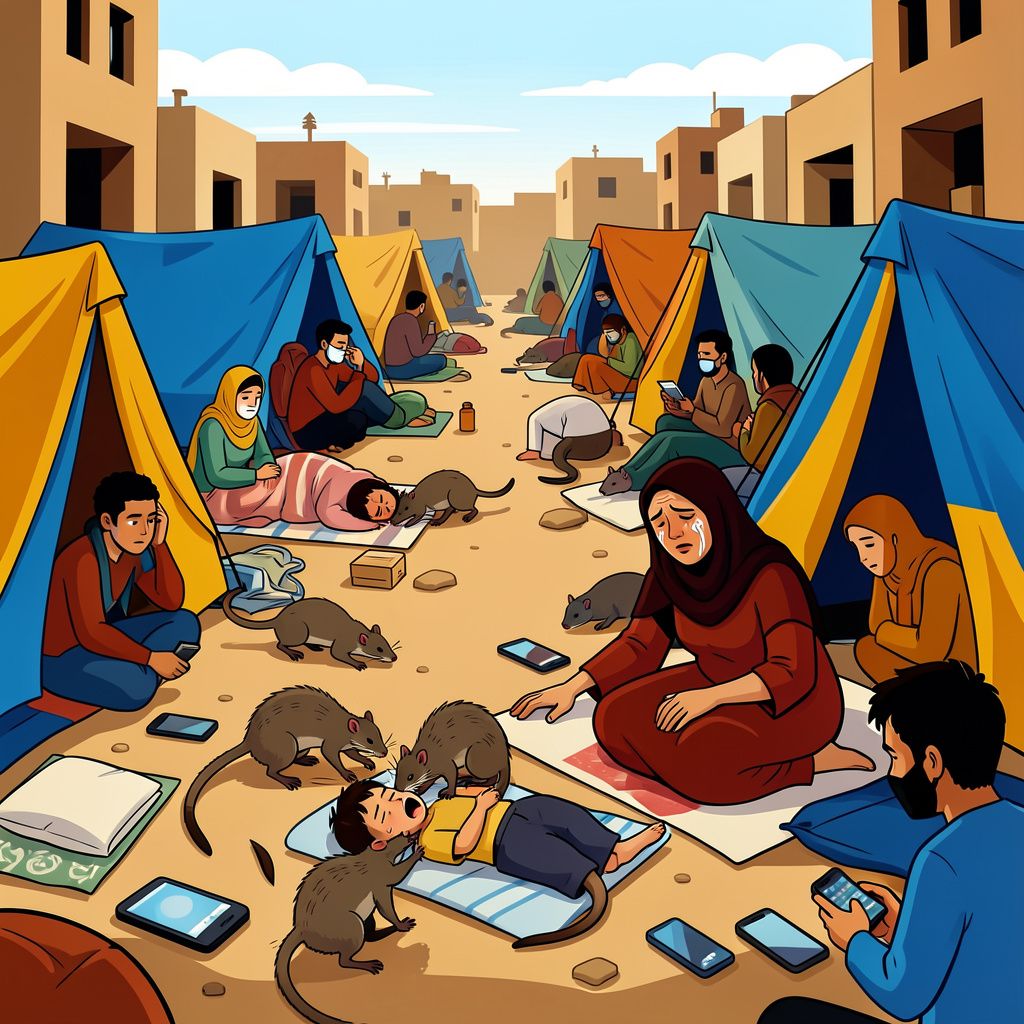
Displaced Palestinians face a horrifying new threat as rats and weasels infest overcrowded camps, attacking sleeping children and vulnerable residents. Four-year-old Mayaseen required tetanus treatment after a weasel bite left her hand bloodied. UN surveys reveal rodents in 80% of sites housing 1.45 million displaced people, with over 111,500 disease cases linked to parasites reported in 2026 alone.
Children Under Attack in Overcrowded Camps
The terror strikes during the most vulnerable moments. Four-year-old Mayaseen was sleeping when a weasel bit her hand, leaving it covered in blood [1]. “When my husband turned on the torch, the weasel ran away. I looked at my daughter’s hand, and it was all blood. Everything was bloody,” her mother Samah al-Daabla recounted [1]. The child required a tetanus injection at a Gaza City hospital following the attack [1]. This incident represents just one of countless similar encounters as displaced families struggle against an enemy they never anticipated fighting alongside the ongoing conflict.
Widespread Infestation Documented Across Displacement Sites
The scale of the rodent crisis has reached alarming proportions across Gaza’s displacement camps. A comprehensive survey cited by UN agencies found rodents or pests visible in 80% of sites where 1.45 million displaced people currently live [1]. Social media footage has captured the disturbing reality of rodents attacking newborn babies, the sick, and the elderly in these camps [1]. Gaza City resident Rizq Abu Laila, who lives near a rubbish dump with his four children, reports experiencing “an abnormal number” of weasels and rats [1]. “We cannot sleep! If we sleep, they bite the children and disturb us. There are so many weasels and rats – an abnormal number,” Abu Laila explained [1]. The overcrowded campsites with raw sewage have become breeding grounds for these rodents [1].
Health Crisis Reaches Critical Levels
The rodent infestation has evolved into a full-blown public health emergency. The World Health Organisation reports 111,500 cases of disease or infestation due to external parasites in 2026 alone [1]. Additionally, over 80% of households report skin infections [1]. Dr Reinhilde Van De Weert, the local WHO representative, described the situation as “unfortunately, the predictable consequence of a collapsed living environment” [1]. The health implications extend far beyond immediate bites and infections, creating conditions that could foster the spread of more serious diseases if left unchecked.
International Response and Ongoing Challenges
International organisations are mobilising resources to address the crisis, though the scale of need remains enormous. Cogat, the Israeli defence body that controls Gaza’s crossings, states it has recently allowed nearly 1,000 rat traps and almost 10 tonnes of pesticides into Gaza [1]. The organisation says it is working with international organisations “to address sanitation needs” [1]. UN agencies are actively working to improve pest control, drainage and sanitation across the affected areas [1]. However, Ettie Higgins, Unicef’s deputy representative for Palestine, emphasises the magnitude of what lies ahead: “What is needed is a very large-scale campaign to be able to deal with the waste and rubble problems across Gaza” [1]. The challenge is compounded by the fact that Gazans lack the 200,000 caravans needed for temporary housing [1]. More than six months after a US-brokered ceasefire deal, progress has stalled, and no reconstruction has occurred [1], leaving families like Abu Laila’s calling for international aid to address their desperate circumstances [1].