

Middle East Conflict Pushes 6 Million More People Towards Starvation, UN Food Agency Warns
Kakuma, 7 June 2026
The WFP warned on 5 June 2026 that conflict involving Iran has driven global food prices higher for a third consecutive month, pushing 2.5 million Somalis, 2.3 million Afghans, and 1.3 million Sri Lankans into severe hunger. With oil near $100 per barrel, 45 million more face crisis.
A Crisis With a Ripple Effect
On 5 June 2026, the World Food Programme (WFP) issued one of its starkest warnings in recent memory, linking the ongoing conflict involving Iran directly to a worsening global hunger emergency [1][3]. The agency’s Acting Executive Director, Carl Skau, speaking at United Nations Headquarters in New York, confirmed that early warnings issued when the conflict first escalated — roughly 100 days before his statement — are now materialising in some of the world’s most vulnerable nations [4]. What began as a geopolitical confrontation in the Middle East has, according to the WFP, transformed into a food security crisis spreading across multiple continents [4].
Who Is Being Hit — and Where
The human cost of this crisis is already measurable. The WFP reports that 2.5 million people in Somalia, 2.3 million in Afghanistan, and 1.3 million in Sri Lanka are now struggling to access sufficient food [1][3][4]. That represents a combined total of 6.1 million people across three countries alone who have been pushed into severe food insecurity as a direct consequence of compounding pressures. Beyond these three nations, the WFP has specifically named Sudan, Gaza, southern Lebanon, Yemen, and Haiti as regions already experiencing acute hunger [3]. The agency stresses that the causes vary by country, but a common thread runs through all of them: rising food prices, insufficient humanitarian funding, and escalating operational costs are collectively reducing the number of people aid organisations can reach with existing resources [4].
Oil, Food, and the Price Chain
Central to this crisis is the relationship between energy prices and the global food supply. Carl Skau was explicit on this point, stating that the link between energy costs and food prices is profound, and that people in the poorest countries are already spending everything they have simply to eat [3]. When food prices rise further, people are forced to eat less [3]. The conflict involving Iran has disrupted supply chains running through the Strait of Hormuz, driving up both shipping and fuel costs [4]. The WFP projects that if the conflict continues and oil prices remain at approximately $100 per barrel through to July 2026, as many as 45 million additional people could be pushed into severe food insecurity [4]. A further 45 million are considered at risk of being driven deeper into hunger due to the close interdependence of energy and food prices [4].
The Consequences for Kakuma and Kalobeyei
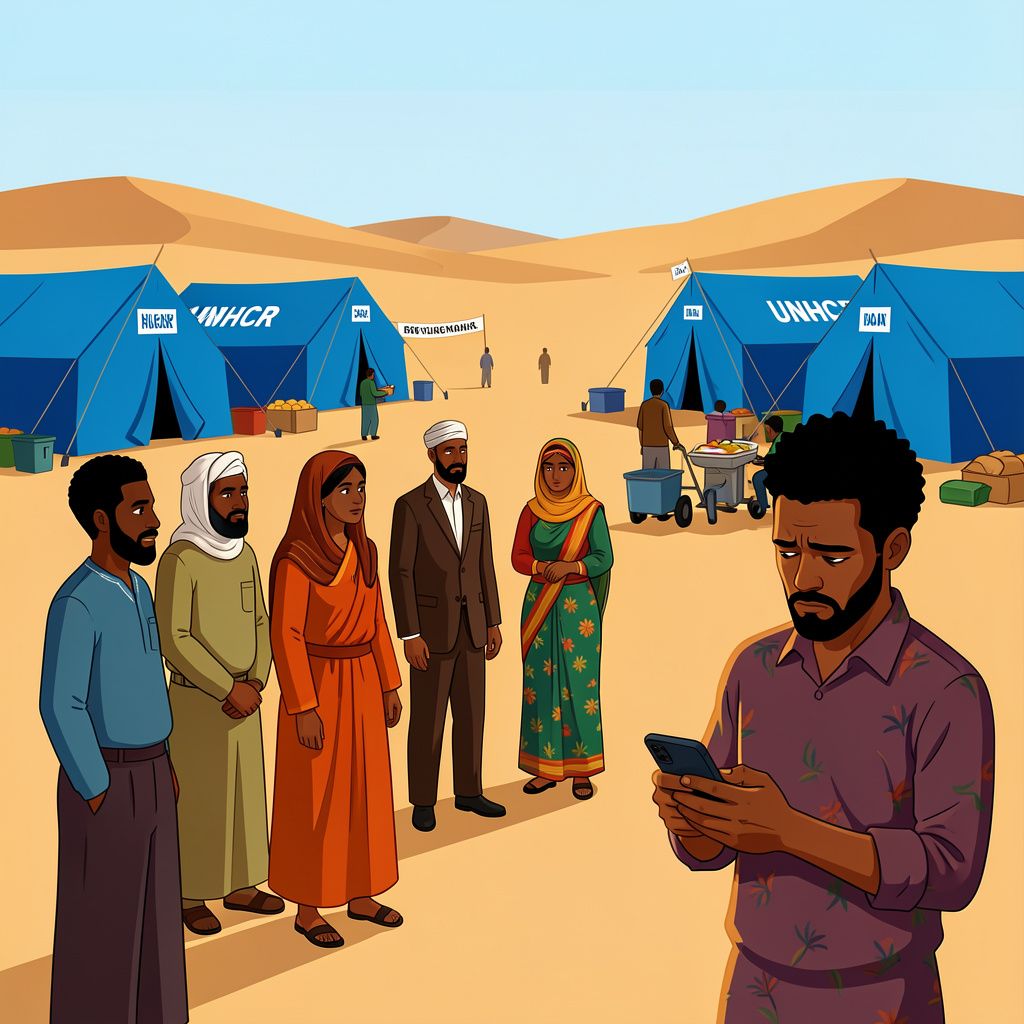
For refugees living in Kakuma refugee camp and the neighbouring Kalobeyei settlement in north-west Kenya, these global dynamics translate into immediate, practical hardship. Both communities already face reduced food rations as a result of WFP funding shortfalls that predate the current crisis [GPT]. As global food prices rise — confirmed to have increased for the third consecutive month in April 2026 by the UN’s Food and Agriculture Organisation [alert! ‘FAO April 2026 food price index data not directly available in the provided sources; referenced in the article brief but not independently confirmed by a cited source’] — WFP’s purchasing power diminishes accordingly, meaning the agency is able to procure less food for the same budget. Ration sizes in both Kakuma and Kalobeyei are already reported to be below recommended daily calorie thresholds [GPT], and any further reduction would deepen the nutritional crisis for a population that has few alternative means of sustenance. Residents of both Kakuma and Kalobeyei are advised to monitor official announcements from UNHCR and WFP camp management closely for updates on upcoming food distributions and any adjustments to ration allocations [GPT].
A Warning About What Comes Next
The WFP is not only sounding the alarm about current conditions — it is warning that the situation may deteriorate further in the months ahead. Skau highlighted that elevated fertiliser costs, a direct consequence of the energy price surge, could suppress agricultural output across East Africa during the next planting season [4]. Should harvests fall short, the food shortfall could deepen considerably in the second half of 2026 [4]. In response, the agency has issued an urgent appeal to international donors to increase humanitarian funding, with particular focus on Somalia and Afghanistan [3]. DW’s Kiswahili service, reporting on 6 June 2026, noted that the WFP’s warning encompassed the broader international community’s responsibility to act before a food emergency becomes a famine [1][6]. As of Sunday, 7 June 2026, no major new donor commitments have been publicly announced in response to this specific warning [alert! ‘No source confirms or denies donor responses made after 5 June 2026’].
Bronnen
- www.instagram.com
- www.facebook.com
- amp.dw.com
- parstoday.ir
- www.facebook.com
- www.dw.com
- news.un.org
- www.facebook.com