

Tanzania Reopens Its Door to Russia After Decades of Distance
Moscow, 7 June 2026
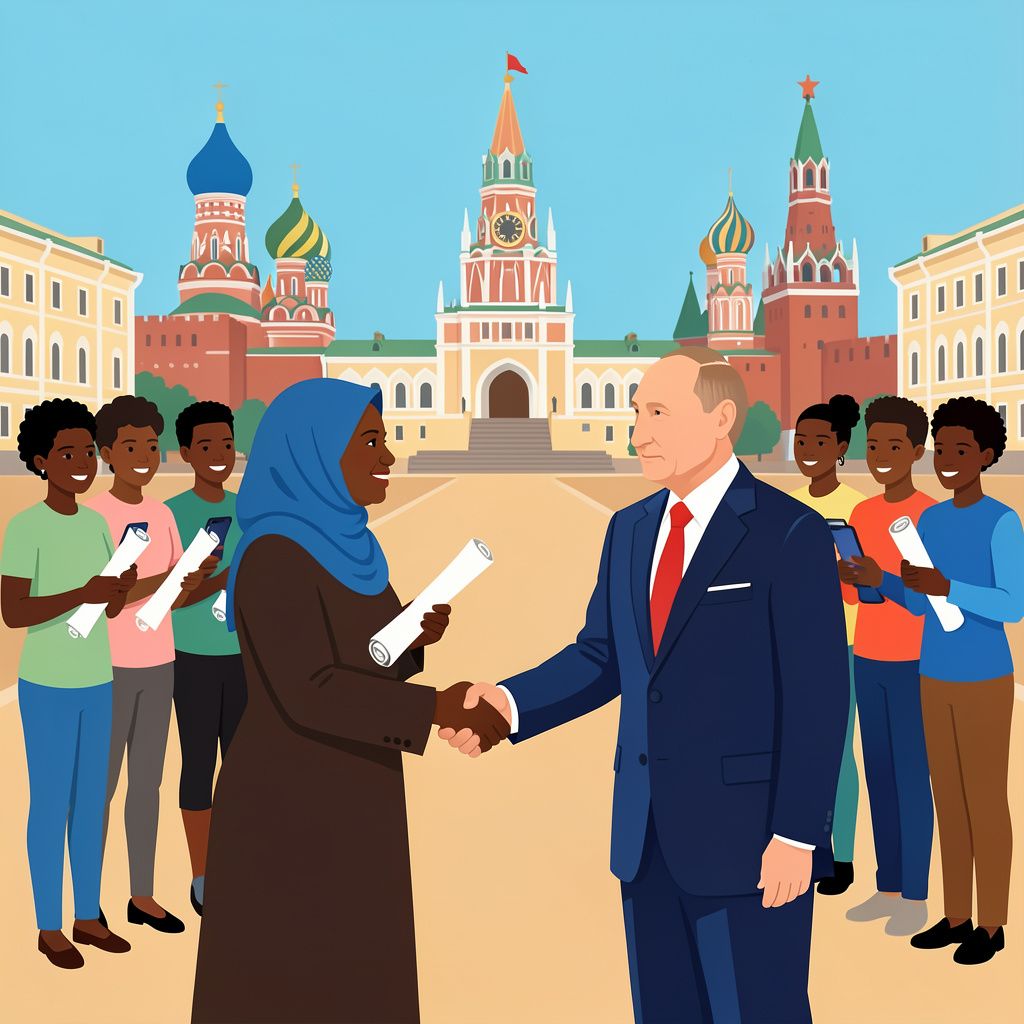
Tanzania’s President Samia Suluhu Hassan completed a landmark three-day state visit to Russia in June 2026 — the first in decades — meeting Putin, receiving an honorary doctorate from Moscow’s Patrice Lumumba University, and unlocking expanded scholarships for Tanzanian youth.
Decades of Distance: Why Tanzania and Russia Drifted Apart
To understand why President Samia Suluhu Hassan’s visit to Moscow in the first week of June 2026 carries such weight, one must first understand why the two nations grew so distant. Speaking directly to Tanzanian journalists during the state visit on 5 June 2026, President Samia pointed to a confluence of historical forces that effectively froze meaningful economic cooperation between Dar es Salaam and Moscow for decades [2]. Chief among these were the sweeping geopolitical shifts of the post-Cold War era and the international sanctions imposed on Russia in subsequent years, both of which made broad-based bilateral engagement increasingly difficult [2].
A New Chapter: Scholarships, Honorary Degrees, and Strategic Signals
The June 2026 visit was not merely symbolic. One of its most immediately tangible outcomes was the expectation of expanded scholarship opportunities for Tanzanian youth studying in Russia [5]. According to data cited at the time of the visit, a total of 570 Tanzanian students were already enrolled across various Russian universities in 2025 [5]. Russia’s cultural centre based in Tanzania had, prior to the visit, been providing higher education scholarships to more than 150 Tanzanian students every year [5]. The visit by President Samia is widely expected to significantly expand that pipeline, broadening access for young Tanzanians to Russian institutions of higher learning [5].
SPIEF 2026 and a Moment That Captured the World’s Attention
Beyond the formal diplomatic agenda, the visit concluded with a lighter moment that nonetheless ricocheted across social media platforms with remarkable speed. At the conclusion of the St. Petersburg International Economic Forum — known as SPIEF 2026 — President Samia inadvertently walked off the stage with her live microphone still attached, dragging the cord behind her [1]. Russian President Vladimir Putin, standing nearby, promptly stepped in and smoothly unclipped and removed the microphone to assist her [1]. The moment, captured on video and widely circulated by outlets including Plug TV Kenya on 6 June 2026, became an unexpected talking point, humanising both leaders in a forum typically dominated by high-stakes economic discourse [1].
What This Means for East Africa — and for the Refugees of Turkana
For the broader East African region, Tanzania’s diplomatic pivot towards Moscow is part of a pattern that analysts have increasingly observed across the continent — African governments diversifying their international partnerships based on national interest rather than historical allegiance [GPT]. For Kenya in particular, whose own diplomatic posture has remained more closely aligned with Western partners, Tanzania’s growing engagement with Russia adds a layer of complexity to regional geopolitics. Trade corridors, security frameworks, and the political dynamics within the East African Community (EAC) could all, over time, be shaped by the trajectory of Tanzania-Russia relations [GPT][alert! ‘No source directly confirms the specific impact on EAC frameworks from this visit’].
The Bigger Picture: Africa’s Diplomatic Recalibration
President Samia’s visit to Russia is best understood not as an isolated bilateral event, but as one data point within Africa’s broader diplomatic recalibration [GPT]. Across the continent, governments from Bamako to Nairobi have been reassessing the terms of their international relationships, driven by frustration with conditional Western aid, the search for new infrastructure financing, and a genuine desire for multi-vector foreign policies that serve domestic development goals [GPT]. Tanzania, under President Samia, has been among the more measured of these voices — pursuing economic pragmatism without the sharp rhetorical edges seen in some other capitals [GPT][alert! ‘This characterisation of Tanzania’s diplomatic tone is analytical inference not directly confirmed by the provided sources’].
Bronnen
- www.instagram.com
- www.instagram.com
- www.facebook.com
- www.instagram.com
- www.instagram.com
- www.threads.com
- www.instagram.com