

Kalobeyei Refugees Block Roads Over Chronic Water Crisis That Has Lasted Years
Kalobeyei, 7 June 2026
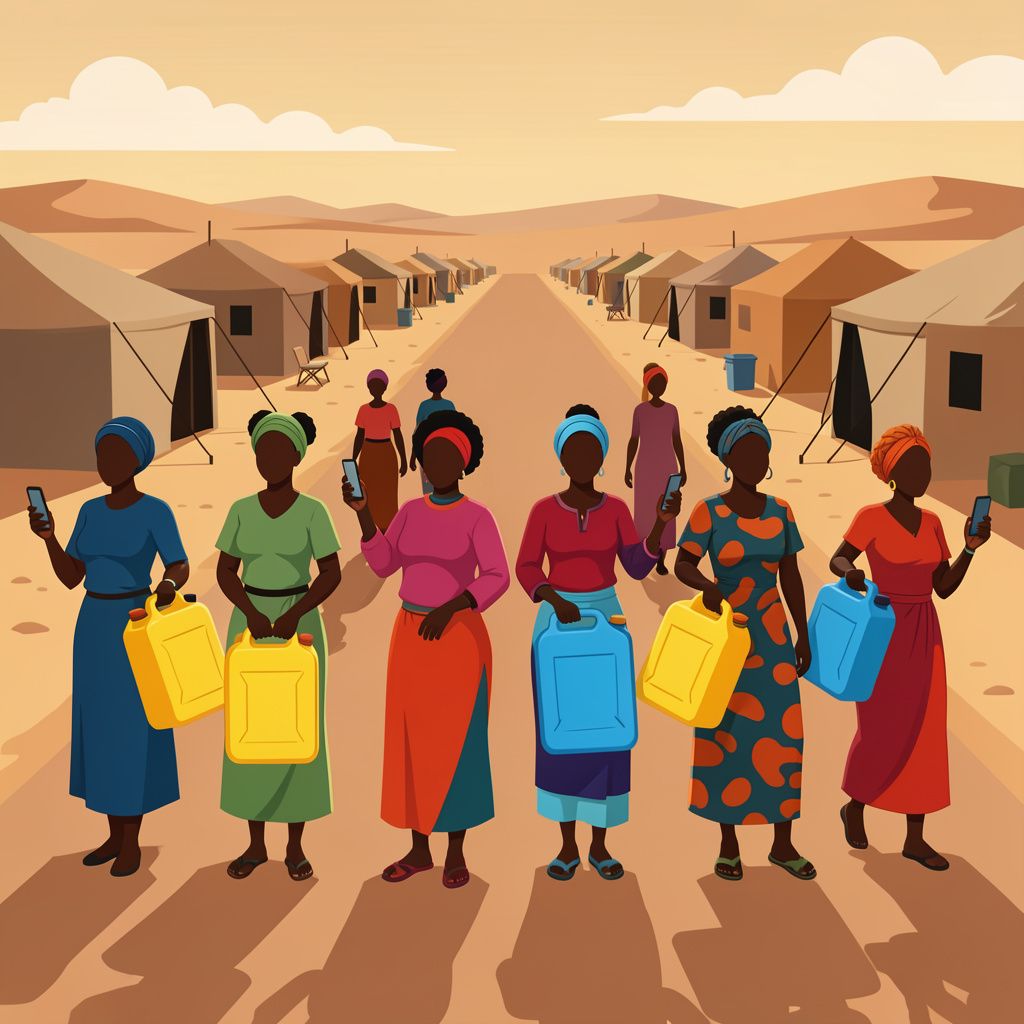
Women and girls carrying empty jerricans took to the streets in November 2022, barricading roads in what exposed a fundamental question: is clean water a need or a right for refugees?
Roads Blocked, Jerricans Empty
On 1 November 2022, residents of Village One and Village Two within the Kalobeyei Settlement reached a breaking point [1]. The main road connecting the settlement to the central business district, Kakuma town, and nearby humanitarian compounds was blocked with stones [1]. The majority of those who came out to protest were women and girls, each holding empty jerricans — the plastic containers used daily to collect water for drinking, cooking, and basic sanitation [1]. The image was stark and deliberately symbolic: vessels designed to carry water, carried instead as evidence of its absence.
Voices From the Ground
The frustration on the ground was not abstract. Halima, a 38-year-old resident of Kalobeyei, spoke directly to a KANERE reporter at the scene of the protest [1]. ‘In my block, water taps are dry for 5 days, but why?’ she asked [1]. She continued: ‘We’ve no clean drinking water all year long, but why? Is it always about a funding issue? People are out here because our situation is bad’ [1]. Her words captured a sentiment shared widely across the settlement — that the water crisis was not a new emergency but a chronic, unresolved failure that had persisted for years before the November 2022 demonstration [1].
A Settlement Built on Promises
Kalobeyei was not conceived as a conventional refugee camp [GPT]. It was established as a model integrated settlement, intended to foster self-reliance among refugees and promote shared access to services alongside the Kenyan host community [GPT]. Yet for many of its residents, that founding vision has gone unfulfilled. A community leader based in Kalobeyei’s Village One, who stated he had moved to the settlement seven years prior to the November 2022 protest — placing his arrival at approximately 2015, when the settlement was being opened — told KANERE: ‘I moved here seven years ago when Kalobeyei was opened with big ideas and promises [than Kakuma]. I realize that it’s all not true because UNHCR and local government cannot fix infrastructural problems here’ [1]. The gap between the settlement’s stated ambitions and its lived reality has become a source of deep disillusionment for long-term residents [1].
A Pattern of Crisis Across the Camp Complex
The November 2022 protest in Kalobeyei did not occur in isolation. Earlier that same year, on the morning of 21 March 2022, refugees from three zones in Kakuma — the older, adjacent refugee camp — marched to the UNHCR main compound in Kakuma One to raise complaints about severe water shortages, which KANERE described as a cross-cutting situation facing camp residents [1]. The two episodes, months apart and at different sites, pointed to the same systemic failure across the broader Kakuma-Kalobeyei complex [1]. Water shortages had become particularly pronounced during a recent dry spell, but residents and community leaders were clear that the problem predated any single weather event and had been raised — without resolution — for years [1]. KANERE’s attempts to contact the responsible implementing agencies at the time of the November 2022 report were unsuccessful, with phone calls going unanswered [1].
Security Pressures Add to a Fragile Environment
Water is not the only pressure bearing down on Kalobeyei and the wider Kakuma camp complex. KANERE’s reporting across the peace and security category documents a sustained pattern of violence and instability in the area [2]. On 7 August 2022 — just months before the water protest — an Ethiopian refugee was shot and killed during a series of violent armed robberies in Village Two of the Kalobeyei settlement itself [2]. Earlier incidents include the injury of at least four refugees in Kakuma in May 2021, following attacks by members of the host community linked to the Kenyan government’s announcement regarding the potential closure of refugee camps [2]. In February 2021, a South Sudanese refugee teenager was killed in Kakuma during a dispute over firewood collection, amid reports of a growing suicide rate among the displaced population [2]. These episodes collectively paint a picture of a camp environment under compounding pressure — where unmet basic needs, funding shortfalls, and security vulnerabilities interact and reinforce one another [2].
The Fundamental Question That Remains Unanswered
KANERE, which had returned from a one-year publishing hiatus in December 2022 after being forced offline by humanitarian funding shortages [2], framed the water crisis with a question that cuts to the heart of refugee rights: is water treated as a need or a right? [1]. The distinction matters. A need can be deprioritised, delayed, or subject to funding cycles. A right, under international humanitarian law, carries obligations that cannot simply be deferred when budgets are tight [GPT]. As of the time of the original reporting in December 2022, no public response had been issued by camp management or the implementing agencies responsible for water provision at Kalobeyei [1]. The roads that were barricaded with stones on 1 November 2022 were eventually cleared [alert! ‘The source confirms roads were barricaded for a number of hours but does not explicitly state when or how they were cleared’], but the question Halima and her neighbours posed — loudly and with empty jerricans in hand — has yet to receive a satisfactory answer.