

Gabriel's First-Ever Penalty for Arsenal Ends in Champions League Final Heartbreak Against PSG
Budapest, 31 May 2026
A defender who had never taken a penalty for his club stepped up in the biggest moment — and Arsenal paid the ultimate price.
The Night That Broke Arsenal Hearts
On the evening of Friday, 30 May 2026, the Puskás Aréna in Budapest, Hungary — a stadium with a capacity of 67,000 — played host to one of the most dramatic UEFA Champions League finals in recent memory [3]. Paris Saint-Germain, the defending champions, faced an Arsenal side that had not appeared in a Champions League final since 2006 [2]. What followed was 90 minutes of gripping, nerve-shredding football that ended 1-1, before PSG claimed the trophy in a penalty shootout that will live long in the memory of supporters on both sides [2]. For the Arsenal faithful gathered in living rooms, fan zones, and community spaces from London to Kakuma, the final whistle of the shootout brought silence where there had been hope.
A Flying Start, Then the Equaliser
Arsenal made the most electrifying of starts. Kai Havertz, one of the club’s most trusted attackers, put the Gunners ahead inside just six minutes, beating PSG goalkeeper Matvey Safonov to send Arsenal supporters into raptures across the globe [2]. The lead, however, did not last. Ousmane Dembélé — whose fitness had been a major question mark heading into the final, having missed training after being substituted in a recent domestic match [alert! ‘previous article context, not confirmed by current sources’] — equalised from the penalty spot for PSG, silencing the Arsenal end and restoring parity [2]. It is worth noting that our earlier reporting, available at PSG Stars Face Fitness Race Against Time for Champions League Final, had flagged both Dembélé and Achraf Hakimi as injury doubts ahead of this match. That Dembélé not only featured but scored the equaliser will sting Arsenal supporters deeply. The score would remain 1-1 through normal time, sending the final to a shootout that would define careers and break hearts.
The Shootout: Three Misses, One Defining Moment
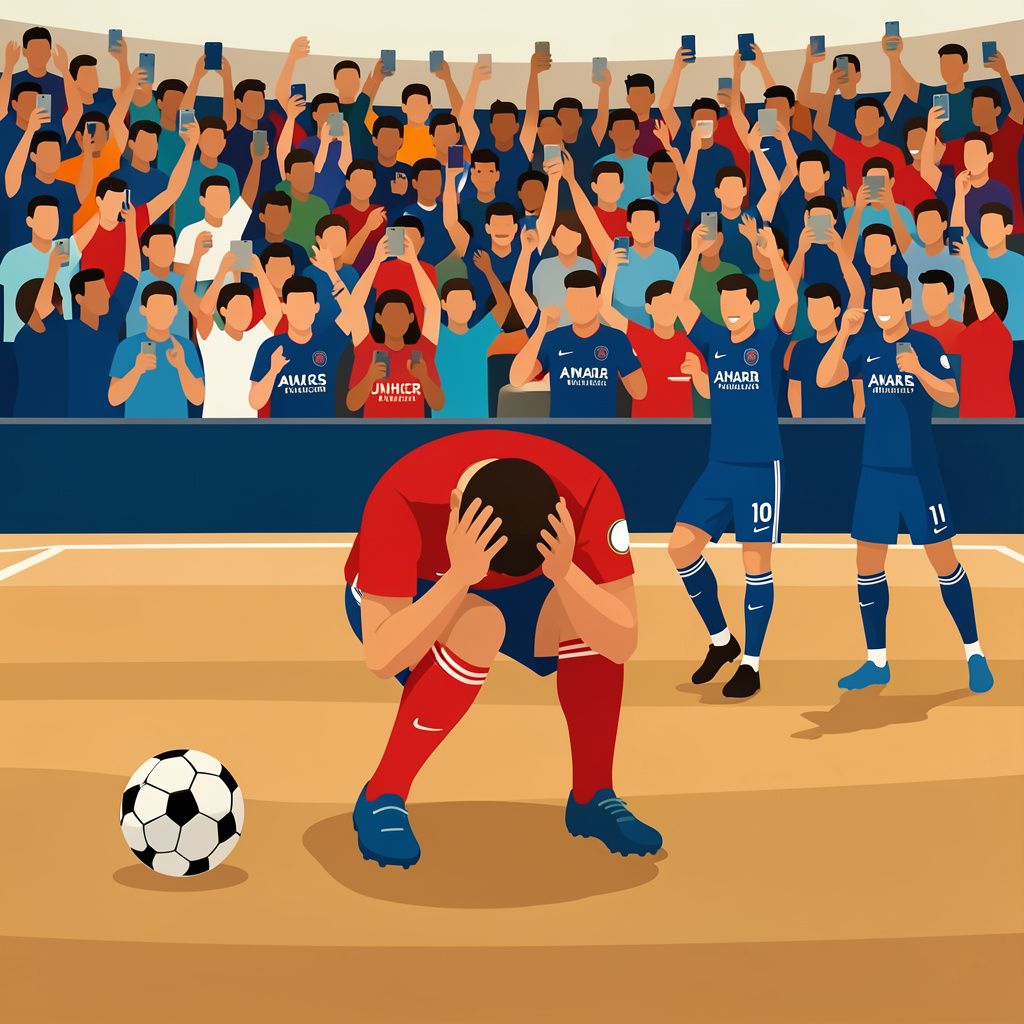
The penalty shootout was a brutal affair. For Arsenal, Eberechi Eze missed his effort, and while goalkeeper David Raya produced a moment of brilliance to save PSG’s Nuno Mendes’ attempt and keep Arsenal’s hopes alive, it was ultimately not enough [2]. When Brazilian centre-back Gabriel stepped forward to take what proved to be the decisive penalty, history was already being made in the most unforgiving way possible: it was the first penalty Gabriel had ever taken for Arsenal [2]. The ball flew over the crossbar, and with it went Arsenal’s dream of a historic Premier League and Champions League double [2]. Paris Saint-Germain were champions of Europe for the second consecutive year [2][3].
A Season of Heroics, a Moment of Heartache
The cruelty of Gabriel’s miss is made all the more stark by the context of his extraordinary season. The defender, signed by manager Mikel Arteta in December 2019, started 48 of Arsenal’s 63 matches in the 2025/2026 campaign and contributed nine goals and assists to the club’s Premier League title victory — a triumph that included a 96th-minute winner against Newcastle United back in September 2025 [2]. On the night of the final itself, Gabriel was Arsenal’s defensive colossus, making a game-high 13 clearances as he marshalled a backline under sustained PSG pressure [2]. His manager, Mikel Arteta, was keen to defend the decision to involve Gabriel in the shootout. ‘He wanted to take it,’ Arteta said, adding: ‘Normally the penalty takers would be Bukayo [Saka], Martin [Odegaard] and Kai [Havertz]. But we knew if the game went to extra-time and penalties, different players would have to step forward.’ [2] Arsenal midfielder Declan Rice was equally generous in his assessment: ‘To miss a penalty in a Champions League final, obviously it’s not nice,’ Rice said [2]. Former Manchester City defender Nedum Onuoha captured the magnitude of the moment: ‘So for him to be the one who misses the penalty that costs them the Champions League final is heartbreaking.’ [2]
History, Legacy, and the Long Road Back
Had Arsenal won, they would have joined an exceptionally exclusive club. The Premier League and Champions League double has been achieved only three times since 1992: by Manchester United in 1999 and 2008, and by Manchester City in 2023 [2]. Instead, Arsenal must reflect on what might have been. The comparison to John Terry’s infamous penalty slip for Chelsea in the 2008 final against Manchester United was drawn immediately by former Arsenal defender Matt Upson, underlining just how painfully these moments echo through football history [2]. Meanwhile, across East Africa, the final was watched with passionate intensity. In Tanzania, Wasafi FM broadcast coverage of the match at a big screen event at the Eden Highland venue, as part of the Retro Tour featuring Diamond Platnumz, with thousands of fans engaging with the contest [4]. Social media accounts from across the region captured the drama, with fans posting updates as the score stood at 1-1 at half-time, noting that ‘PSG are pressing hard but Arsenal’s wall is standing firm’ [6][alert! ‘Translation from Swahili; nuance may vary’]. In Kakuma and Kalobeyei, where Arsenal commands a large and devoted following among the refugee community, the result will fuel passionate debate for weeks to come [GPT]. Gabriel, for his part, is scheduled to represent Brazil in the summer of 2026 [2] — a stage on which he will have every opportunity to rewrite his own narrative. The Champions League trophy, meanwhile, returns to Paris for a second successive year [2][3].
Bronnen
- www.bbc.com
- www.reddit.com
- kiswahili.tuko.co.ke
- www.instagram.com
- www.instagram.com
- www.instagram.com