

Nigeria Flies Home Hundreds of Citizens as South Africa's Anti-Migrant Violence Forces a Mass Exodus
Johannesburg, 11 June 2026
With a 30 June 2026 deadline set by armed groups for undocumented migrants to leave South Africa, Nigeria has begun evacuating its citizens, with the first 268 returnees landing in Lagos today amid a deepening diplomatic crisis.
A Flight Home, and a Crisis Laid Bare
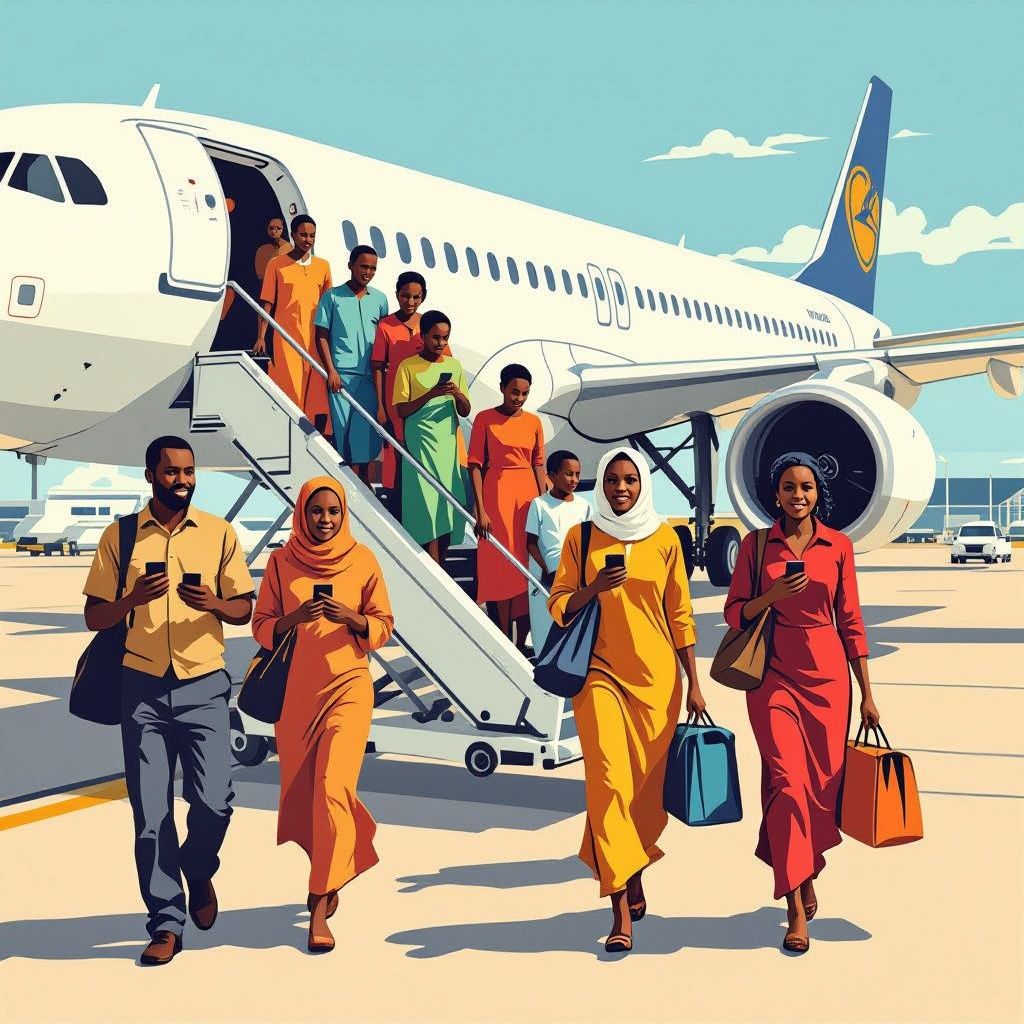
At approximately 11:00 am on Thursday, 11 June 2026, an Air Peace flight touched down at Murtala Muhammed International Airport in Lagos, carrying the first batch of Nigerian nationals evacuated from South Africa [7][8]. The number of returnees on board is reported variously as 258 [7] and 268 [1][8], with Nigerian Foreign Minister Bianca Odumegwu-Ojukwu confirming 262 Nigerian nationals and three officials on the aircraft in addition to the airline crew [4]. The flight had departed Oliver Tambo International Airport in Johannesburg earlier that morning [4]. Waiting to receive them were officials from the National Emergency Management Agency (NEMA), the Nigeria Immigration Service, the Nigerians in Diaspora Commission (NiDCOM), and the Federal Airports Authority of Nigeria (FAAN), alongside Minister of State for Foreign Affairs Sola Enikanolaiye and Acting High Commissioner Temitope Ajayi [7][8]. The evacuation had been ordered by President Bola Ahmed Tinubu and was fully funded by the Nigerian Federal Government [4][6].
The Violence Driving People Out
The scenes at Lagos airport on 11 June 2026 were the direct result of a sharp and dangerous escalation in anti-migrant violence across South Africa. Armed mobs have been going door-to-door in cities, intimidating, beating, and forcing foreign nationals from their homes [7]. The violence has not been indiscriminate in its targets — it has cut across nationalities. Two Nigerian men were killed in April 2026: Amaramiro Emmanuel, who was beaten by South African National Defence Force officers on 20 April 2026, and Ekpenyong Andrew, who was found dead in a Pretoria mortuary [2]. On 2 June 2026, five Mozambican citizens were killed as a direct consequence of xenophobic attacks, with two more dying in a road accident whilst fleeing [2]. South Africa, which Statistics South Africa recorded as hosting 2.4 million foreign nationals in 2022 — representing approximately 3.692 per cent of its 65 million population [2] — has seen three major waves of anti-immigration violence since 2008 [2]. The worst, in 2008, killed 62 people in Alexandra, Johannesburg alone [2]. The 2026 wave now ranks among the most serious, prompting multiple governments to act simultaneously.
A Continent Reacting: Ghana, Mozambique, Malawi, and Nigeria
Nigeria is not the only country to have responded with emergency repatriation. Ghana repatriated over 1,000 citizens from South Africa, with South Africa’s Border Management Authority reporting that 663 Ghanaians were repatriated over the weekend of 6–7 June 2026, of whom 321 had overstayed their visas by 30 days or more [2]. Mozambique repatriated more than 700 citizens from South Africa’s Western Cape region [2]. Malawi has also completed evacuations [1]. The scale of the collective response reflects the severity of the situation on the ground. Ghana’s Foreign Minister Samuel Okudzeto Ablakwa highlighted the lack of accountability in South Africa, stating bluntly: “Not a single Ghanaian so far has been arrested” [2]. For Nigeria, more than 1,000 citizens had registered their desire to leave South Africa before the first flight departed [1][3][6], underscoring the depth of fear among the Nigerian community there. As hairdresser and mother-of-three Chinwe Osuala, who was among those returning, explained: “You can’t even walk around freely. You’ll be scared, the children are scared — that’s the main reason I came back, because of the children” [1].
Ramaphosa Speaks, But Critics Say It Is Not Enough
On Sunday, 7 June 2026, South African President Cyril Ramaphosa delivered a televised address in which he announced a package of measures to tackle illegal migration [1][2]. These included jailing employers of undocumented workers, establishing dedicated deportation courts, and creating a national biometric database for migrants [1]. Ramaphosa acknowledged the complexity of the issue, stating: “Many South Africans are asking difficult but legitimate questions,” whilst also cautioning that “illegal immigration is not the cause of all our economic challenges” and that South Africa’s history is itself “a product of migration” [2]. South Africa’s unemployment rate currently exceeds 30% [1][2], a figure that has long served as the underlying economic tinder for anti-migrant sentiment [GPT]. Despite Ramaphosa’s address, critics were unconvinced. Public Affairs Analyst Kenny Okolugbo, speaking on 10 June 2026, stated that the speech “did not offer enough protection” and that Nigeria should have taken the lead in evacuating its citizens far sooner, describing the process as having been too slow [3]. Nigeria’s own Consul General in South Africa, Ninikanwa Okey-Uche, was pointed in his assessment: “migrants are basically being scapegoated,” and added that those orchestrating the violence “are not hiding. They’ve caused mayhem in people’s lives, but they’re walking free. Some of them are running for election” [1].
Diplomatic Fault Lines and a Looming Deadline
The evacuations have opened a significant diplomatic rift between Abuja and Pretoria. On 8 June 2026, Nigerian Foreign Minister Bianca Odumegwu-Ojukwu formally accused South Africa of failing to denounce the xenophobic violence, with Nigeria threatening retaliatory measures against South African nationals, businesses, and interests [2][4]. Odumegwu-Ojukwu reminded Pretoria of Nigeria’s historical solidarity with South Africa during the struggle against apartheid, stating: “Nigeria is not happy because Nigeria has sacrificed much for the South African independence struggle” [2]. The Nigerian police also issued a warning on 31 May 2026, with spokesman Aliyu Giwa stating that “reprisal attacks against South African nationals, businesses, or interests in Nigeria will not be tolerated” [2]. Hanging over all of this is a hard deadline set not by any government, but by anti-immigration campaigners: all irregular foreign nationals have been warned to leave South Africa on or before 30 June 2026, under threat of violence [1][2][7]. The South African government has issued no such deadline and has not endorsed it [2], but the threat alone has been enough to push hundreds of families onto repatriation flights. South Africa is also scheduled to hold local government elections in November 2026, with migration already a dominant campaign issue [1] — a political dynamic that analysts suggest complicates any government effort to offer protection to foreign nationals.
What This Means for Refugees and Migrants Across the Region
For refugees and asylum seekers across East Africa — including those in camps such as Kakuma and Kalobeyei in Kenya — the events unfolding in South Africa carry a direct and sobering warning. South Africa has historically been one of the continent’s primary destinations for those seeking economic opportunity or protection [GPT]. The current crisis demonstrates that legal residency status alone does not guarantee safety: Nigeria’s Consul General noted that documentation delays — not deliberate lawbreaking — left many Nigerian nationals without valid papers [1], and South Africa’s Border Management Agency confirmed that many evacuees lacked legal residency documents [1]. Returnees are now undergoing documentation, profiling, and medical checks upon arrival in Lagos, and will receive temporary accommodation whilst arrangements are made to transport them to their home states across Nigeria’s 36 states [1][7]. The Nigerian Diaspora Commission, led by Abike Dabiri-Erewa, confirmed that each returnee would receive over 100,000 naira — equivalent to approximately £55 or $73 — along with mobile phone credit to help them re-establish contact with family [1]. The Federal Government’s Foreign Affairs Ministry was clear that the evacuation was not a signal of defeat: “No Nigerian should live in fear simply because of their nationality. The evacuation does not signal defeat; it underscores the proactive and citizen-centred foreign policy of the Tinubu administration” [7]. More flights are expected in the coming days as the evacuation continues [7].