

China Eliminates All Import Tariffs for African Goods in Historic Trade Move
Nairobi, 1 May 2026
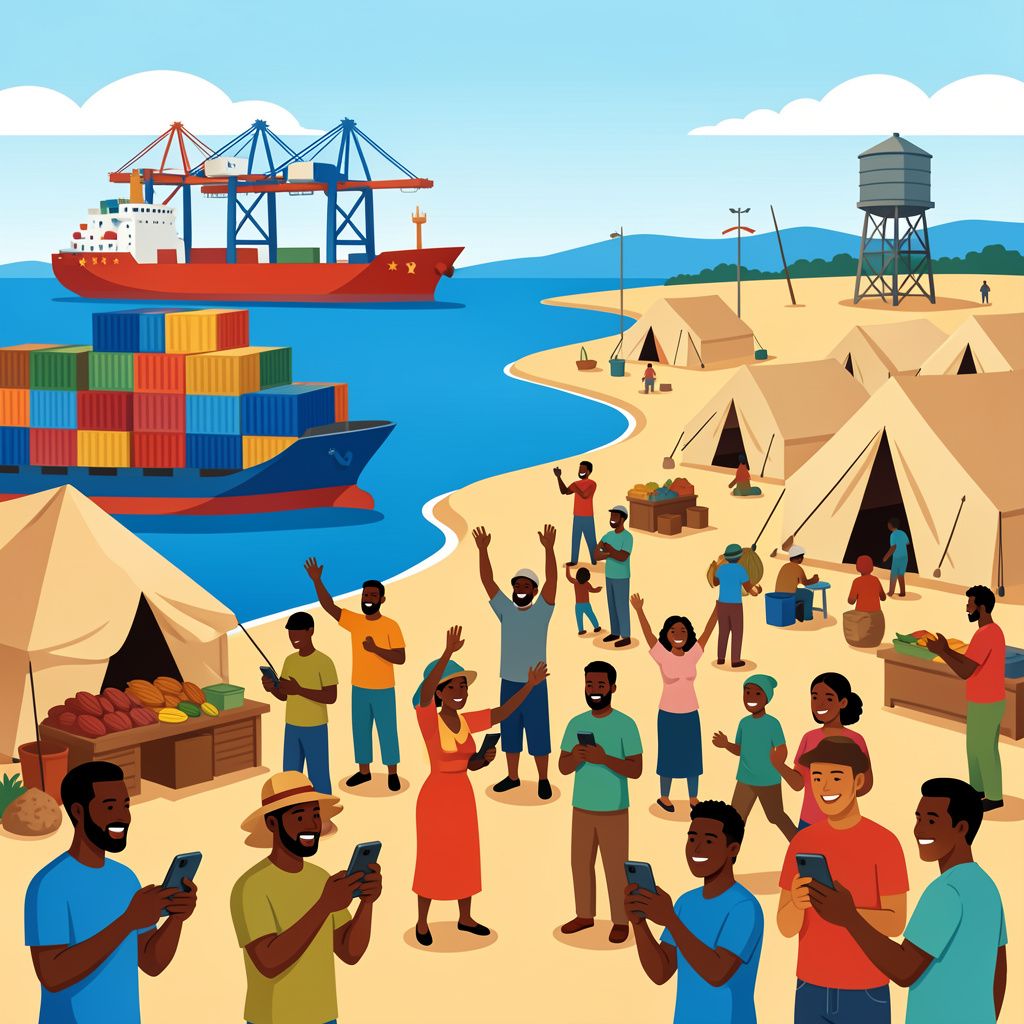
China’s sweeping zero-tariff policy covering all 53 African diplomatic partners could transform continental trade dynamics and reshape global commerce. The initiative addresses stark trade imbalances, with Kenya importing $4.32 billion from China whilst exporting merely $0.21 billion. Cameroon’s cocoa farmers, facing 75% price drops, view the policy as salvation for their struggling industry. Enhanced shipping routes and Chinese port investments signal Beijing’s commitment to deeper African commercial penetration beyond traditional resource extraction.
Immediate Implementation Creates Market Access Opportunities
The zero-tariff policy, which came into effect today, 1 May 2026, expands upon China’s previous arrangements that granted duty-free access to 33 least developed African countries from December 2024 [1]. The comprehensive policy now covers all 53 African nations with which China maintains diplomatic relations, removing import duties on a vast array of African goods including coffee, nuts, and farm produce [1]. Chinese Ambassador to Kenya Guo Haiyan emphasised that China intends to ‘boost trade, multiply benefits for African people, help Africa access the enormous opportunities of the Chinese market, and deliver tangible benefits to the continent’ [2]. The first consignment of Kenyan goods under this arrangement is expected to arrive in Chinese ports during the first week of May 2026, marking the policy’s immediate practical implementation [2].
Addressing Massive Trade Imbalances Across the Continent
The policy directly tackles significant trade disparities that characterise China-Africa commerce, where bilateral trade exceeds $300 billion annually but most African countries import substantially more than they export to China [2]. Kenya exemplifies this imbalance, having exported approximately $210 million worth of goods to China whilst importing $4.32 billion, creating a trade deficit of 4110 million [2]. This 1957.143 per cent difference highlights the stark asymmetry the new policy aims to address [2]. The zero-tariff measures represent China’s strategic response to reduce these imbalances and boost African export capabilities across multiple sectors [2].
Transforming Agricultural Sectors and Rural Livelihoods
Cameroon’s cocoa industry demonstrates the policy’s potential transformative impact on African agricultural sectors. The country produces over 300,000 tonnes of cocoa annually through an industry employing more than 500,000 farmers, but has suffered severe price volatility with cocoa prices falling as much as 75 per cent by early 2026 [3]. George Wambo Cornyu, who operates a cooperative in Masoka and Ikata villages, described the zero-tariff policy as ‘the best news for us as farmers’, noting that farmers ‘will be very happy to hear that we are going to sell our produce at zero tariff. That has never happened’ [3]. Solomon Malu from Cameroon’s Ministry of Agriculture and Rural Development confirmed that ‘with the zero-tariff policy, our cocoa beans will access the vast and broader Chinese market. This will definitely improve the livelihoods of farmers and, in a way, improve the country’s economy’ [3].
Infrastructure Investment and Value Chain Integration
The policy’s effectiveness depends heavily on enhanced shipping infrastructure, with China strategically expanding its presence in African ports to improve commercial access [2]. State-owned Cosco Shipping has launched new maritime routes connecting Qingdao Port to key African destinations including Dar es Salaam, Mombasa, and Durban [2]. Elijah Mbaru, CEO of the Kenya Ship Agents Association, noted that ‘the combination of tariff reductions and improved shipping links will create new opportunities for businesses in both regions’ [2]. Beyond immediate trade facilitation, the zero-tariff policy aims to attract Chinese industrial investment into Africa, promote integration into global value chains, and shift local economies from raw material dependence to higher added-value activities including processing, packaging, branding, and manufacturing [1]. This strategic approach utilises established platforms such as the Forum on China-Africa Cooperation and China-Africa Economic and Trade Expo to deepen comprehensive economic partnerships [1].