

Jesuit Priest Documents Four Months Among 300,000 Refugees in Kenya's Kakuma Camp
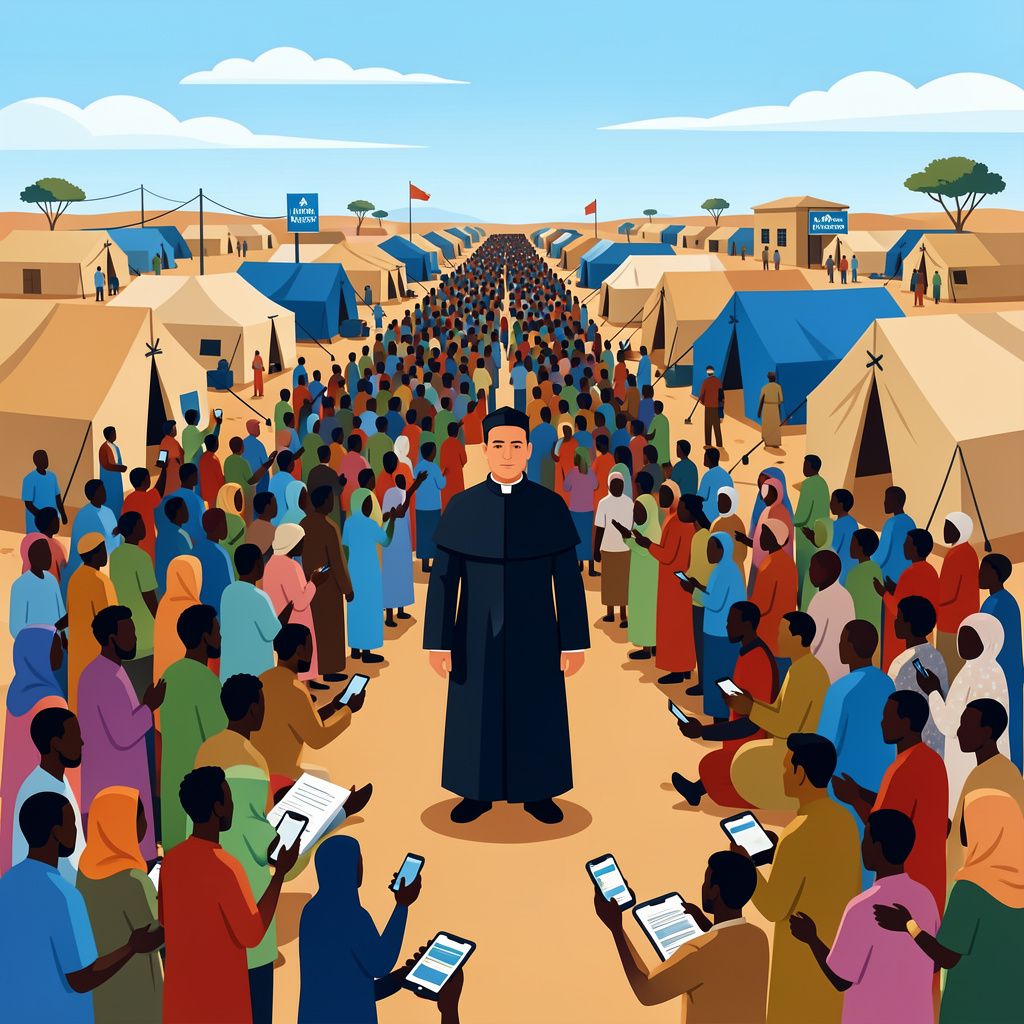
Kakuma, 12 May 2026
Father Bill O’Neill’s extraordinary journey reveals how art and human connection transformed his understanding of hope amidst despair in one of the world’s largest refugee settlements.
From Academic Halls to Refugee Settlements
Father Bill O’Neill, S.J., professor emeritus of social ethics at Santa Clara University’s Jesuit School of Theology, embarked on what was initially planned as a four-month commitment to the Jesuit Refugee Service in late 2019 [1]. However, this mission to Kakuma refugee camp in Kenya extended into a transformative three-year experience that would fundamentally alter his perspective on suffering and hope [1]. The camp, which houses more than 300,000 refugees from 20 countries, became the backdrop for profound lessons about human resilience and the power of artistic expression [1].
A Unique Lens on Displacement
O’Neill brought an unusual perspective to his refugee work, shaped by his 1974 encounter with artist Daryl Cornish in St. Louis, who taught him to understand art and find the ‘inscape’ of paintings [1]. This artistic sensibility proved invaluable as he navigated what he described as ‘the grey anonymity of suffering’ in refugee camps across Tanzania, Rwanda, Kenya, South Sudan, and Uganda [1]. His background in social ethics, combined with his artistic appreciation, allowed him to see beyond the overwhelming statistics of displacement to discover individual stories of remarkable courage and creativity.
Stories of Resilience and Transformation
Among the most poignant experiences was O’Neill’s relationship with Fabien, a 14-year-old refugee from the Democratic Republic of the Congo, whom he assisted with medical care in Nairobi and eventual resettlement in Saskatchewan, Canada [1]. Fabien was ultimately placed with the family of Alain, another refugee who had befriended O’Neill during their shared period of waiting [1]. These personal connections illuminated the profound impact that individual relationships can have in circumstances of mass displacement, demonstrating how hope emerges through human connection rather than institutional intervention alone.
The Daily Reality of Camp Life
Life in Kakuma presents daily challenges that would test anyone’s resolve. Recent social media documentation reveals that eating three meals a day remains a luxury for many residents, with families gathering around simple meals of ugali, beans, rice, and vegetables [3]. Yet even with limited resources, families continue to share what they have and maintain hope for the future [3]. The camp has become home to voices like Peter Kidi, a poet, writer, and refugee activist living in Kakuma, who uses art as a tool for advocacy and documents the realities of life in the settlement—from food cuts and water shortages to protests and the struggle for dignity [4]. His work, featured in collaborations with institutions such as the London School of Economics, Oxfam, and King’s College London, amplifies both refugee and host community voices [4].
Lessons in Hope and Privilege
The experience taught O’Neill profound lessons about privilege and despair, encapsulated in a colleague’s observation: ‘Bill, we who are privileged cannot afford the luxury of despair’ [1]. This insight resonated deeply as he witnessed refugees like Fabien and Alain demonstrate remarkable resilience despite facing uncertain futures [1]. The priest’s time in Kakuma coincided with broader refugee success stories, including those of Mary, Taban, Yar, and Nun—former Kakuma residents who have since found new homes in Mexico through the Habesha Project [2]. These students from South Sudan have embraced their new environment despite cultural challenges, noting that ‘It’s like two parallel worlds moving in opposite directions, as if they could never meet,’ yet finding that Mexico’s reputation for hospitality exceeded their expectations [2]. Their perspective on education as investment—‘because we have the potential to grow, prosper, and create meaningful changes in society’—reflects the transformative power that O’Neill witnessed firsthand [2].