

Nairobi Pipeline Burst Leaves 12 Districts Without Water as Repairs Continue
Nairobi, 2 May 2026
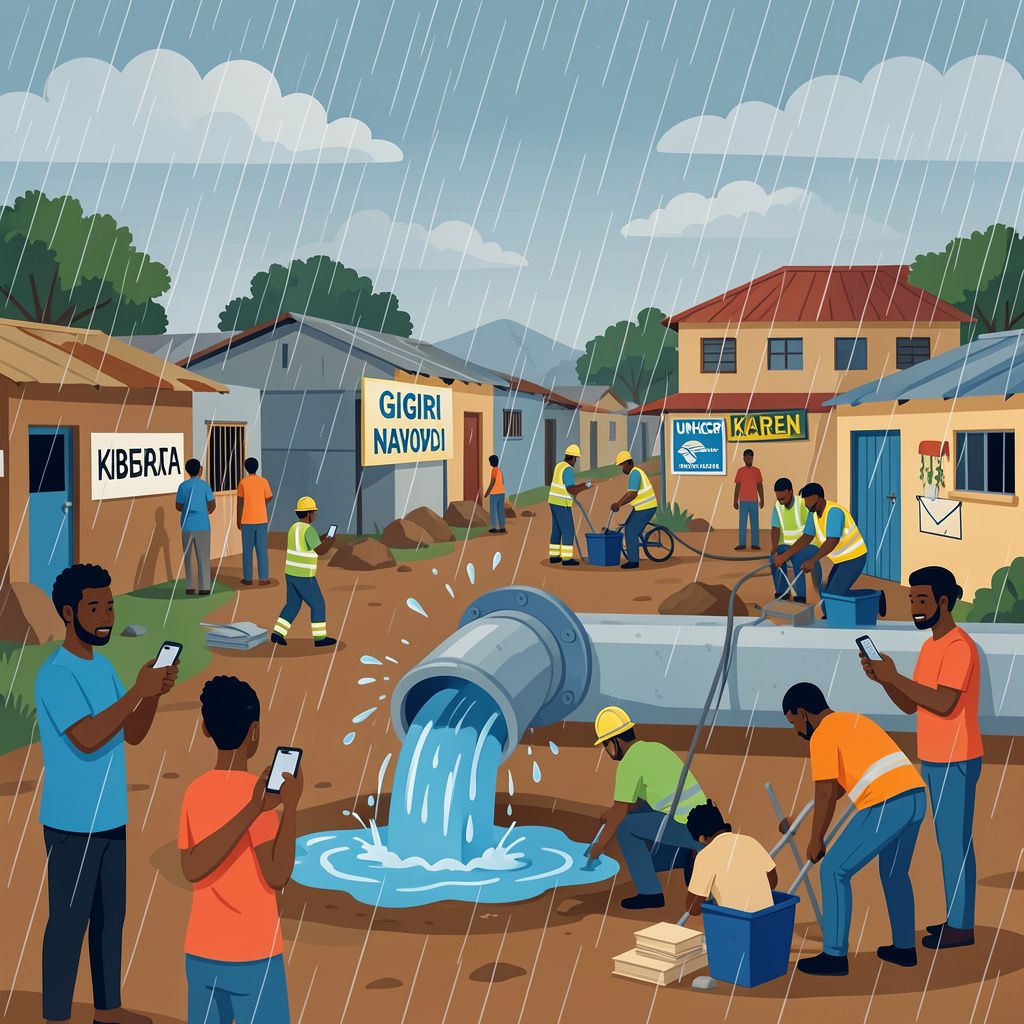
A major water pipeline burst in Gigiri on 1 May 2026 has disrupted supply to twelve Nairobi areas, from affluent Karen to densely populated Kibera slums. The infrastructure failure exposes vulnerabilities in Kenya’s capital as repair teams work to restore service by Saturday morning. Ironically, the disruption occurs amid heavy rainfall that has boosted dam levels, highlighting how ageing infrastructure struggles even during periods of water abundance.
Widespread Disruption Across Economic Divide
The Nairobi City Water and Sewerage Company (NCWSC) announced the temporary water supply disruption on 1 May 2026, affecting twelve residential and commercial areas due to a burst on the NCT–Kigoro–Gigiri–Kabete transmission pipeline [1]. The affected neighbourhoods span Nairobi’s economic spectrum, including affluent areas such as Westlands, Lavington, Kilimani, and Karen, alongside informal settlements like Kibera, as well as commercial districts including Upper Hill, Kileleshwa, Ngong Road, Madaraka, Nairobi West, Uthiru, and Lang’ata [1]. For refugees and displaced persons considering relocation to Kenya’s capital, this incident demonstrates how infrastructure failures can simultaneously affect both wealthy neighbourhoods and vulnerable communities, highlighting the shared risks of urban water dependency regardless of economic status.
Emergency Response and Timeline for Restoration
Repair teams from both the Athi Water Works Development Agency (AWWDA) and Nairobi Water commenced immediate work to address the pipeline breach [1]. Water supply was expected to resume by 06:00 on 2 May 2026, with Nairobi Water stating that ‘water supply is expected to resume by 6am on Saturday, May 2, 2026’ and expressing regret for ‘the inconvenience caused’ whilst appreciating ‘the patience and understanding of its customers as efforts continue to restore normal service’ [1]. Residents across the affected areas have been advised to conserve water and use existing supplies sparingly, with bowser services made available for priority needs during the disruption period [1]. The quick mobilisation of repair resources and alternative water provision demonstrates the city’s emergency response capabilities, though the incident underscores infrastructure vulnerabilities that affect all residents equally.
Weather Patterns Add Complexity to Water Management
The pipeline burst occurs during a period of contrasting weather conditions that complicate Nairobi’s water management challenges. The Kenya Meteorological Department released a forecast on 1 May 2026 indicating that whilst the first week of May 2026 is expected to remain wet with heavy downpours across several regions, ‘the second half of the month is likely to be drier than average, implying the cessation of the March–April–May 2026 rainfall season’ [1]. Heavy rainfall is expected to continue across the Central Highlands including Nairobi, Western Kenya, the Lake Victoria Basin, the Southeastern Lowlands, the Central and South Rift Valley, and North-eastern Kenya during the early May period [1]. Despite current water shortages caused by infrastructure failure, water levels in key dams have surged, ensuring what should be a stable water supply [1]. This paradox illustrates how even during periods of water abundance, ageing infrastructure can create artificial scarcity.
Infrastructure Challenges During Climate Transition
The current water disruption highlights critical infrastructure weaknesses occurring precisely during heavy rains, when water supply should theoretically be most secure [1]. As Kenya transitions from the March–April–May 2026 rainfall season to drier-than-normal weather expected to prevail across much of the country by the final weeks of May 2026, the timing of this infrastructure failure reveals the fragility of urban water systems [1]. For displaced populations and refugees who may depend on Nairobi’s infrastructure, this incident demonstrates that water security challenges can emerge not only during droughts but also when ageing pipeline systems fail under operational pressure. The contrast between abundant natural water resources and compromised distribution infrastructure underscores the complex urban planning challenges facing Kenya’s rapidly growing capital, where both affluent residents and vulnerable communities like those in Kibera face identical risks when critical infrastructure fails.