

Ancient Goat Gut Readings Meet Modern Science as Kenya's Drought-Stricken Turkana Region Awaits Rain
Turkana, 30 May 2026
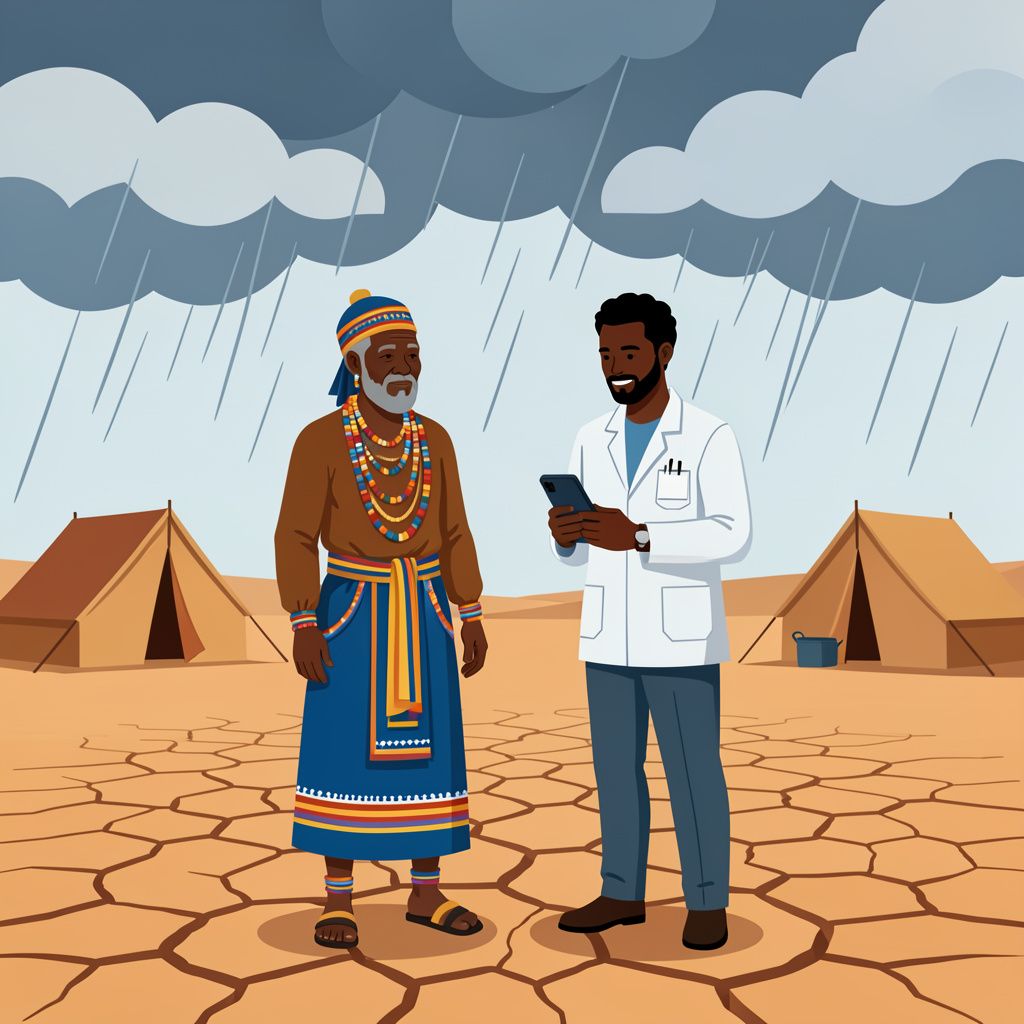
A traditional Turkana seer predicted heavy rainfall on 29 May 2026 by reading a goat’s intestines — a method a Kenyan government meteorologist admits is ‘usually 100% correct’.
A Ritual Older Than the State
In the thorny bush of northern Kenya, on 29 May 2026, a goat was slaughtered — not for food, but for knowledge. Elder and emuron Lochuch Puluk Lotukoi performed the akiteyen ceremony, a traditional Turkana weather forecasting ritual in which the intestines of a sacrificed goat are carefully examined for outlines and colourings that, to a trained seer, reveal what the sky intends to do next [1]. The ceremony was conducted in the presence of local elders, representatives from the county office, and — notably — a professional meteorologist from the Kenyan Weather Service [1]. What Lotukoi read in the gut of that goat was unambiguous: ‘Rain will come!’ [1]
When Science Defers to Tradition
The presence of Alan Kiptoch, meteorologist of the Kenyan Weather Service based in Lodwar, at the akiteyen ceremony was itself a telling detail. Kiptoch, a man trained in the instruments and datasets of modern atmospheric science, did not dismiss the ritual. On the contrary, he acknowledged its track record with striking candour: ‘I have no idea how they do it — but their forecast is usually 100% correct,’ he said [1]. That admission, from a serving government scientist, speaks to a quiet but significant convergence that is taking place in Turkana County — one where indigenous ecological knowledge and formal meteorology are finding reason to sit beside one another rather than in opposition. Sparse rainfall had already been recorded in the Turkana region in the days immediately leading up to the 29 May ceremony [1], lending the ritual an additional layer of immediate relevance.
Decades of Shifting Skies
Lotukoi’s authority as a forecaster is not simply ceremonial — it is rooted in lived observation spanning decades. The emuron first noticed shifting rain patterns as far back as 1999, a period that aligns with the broader acceleration of climate variability documented across the Horn of Africa [1][GPT]. The consequences of those shifting patterns became devastatingly concrete in 2022, when early rainfall caused pasture to dry up prematurely, leading to the deaths of most of the community’s livestock [1]. For Turkana pastoralists, whose entire way of life is organised around the movements of herds across arid and semi-arid land, the loss of livestock is not merely an economic blow — it is an existential one [GPT]. That 2022 drought stands as a recent and raw reference point for why the question of whether rains will hold matters so profoundly to every community member watching the sky.
Cross-Border Tensions and the Search for Solutions
When rains fail in Turkana, herds move. That movement does not stop at international boundaries. During droughts, Turkana pastoralists historically migrate their livestock into the Karamoja region of north-eastern Uganda in search of water and grazing land — a practice that has long carried the risk of armed conflict between communities competing for the same scarce resources [1]. Recognising this pattern, Samuel Ikeny of the local council’s climate change programme described plans to establish governance structures that could pre-empt violence: ‘This is why we are organising cross-border peace councils when the emuron suggests to take the herds into Uganda,’ he said [1]. The framing is significant — the peace councils are to be triggered not solely by government data or humanitarian alerts, but by the readings of the emuron himself [1]. For the large refugee population of Kakuma and Kalobeyei, both situated within Turkana County [alert! ‘the source does not explicitly quantify the refugee population figure; no number is cited’], the stability of cross-border relations has direct consequences. Conflict over water and grazing land along the Kenya–Uganda border can affect movement, security conditions, and the flow of goods that sustain livelihoods both inside and outside the camps [GPT]. A season of sufficient rain, as Lotukoi predicts, could ease those pressures considerably — reducing the need for cross-border migration and the tensions that accompany it.
What the Rains Mean for Refugees and Host Communities Alike
The Turkana region hosts one of the world’s largest refugee settlements [GPT], and the ecological conditions of the surrounding land shape daily life within those settlements as much as formal humanitarian logistics do [GPT]. When drought persists, water scarcity intensifies, local food prices rise, and pasture disappears — straining the relationship between refugee populations and the host communities who share the same depleted environment [GPT]. Even modest rainfall, of the kind already observed in the days before the 29 May ceremony [1], can begin to reverse those dynamics: pasture regenerates, water sources replenish, and the immediate pressure on both communities softens. Lotukoi’s prediction of heavy rain arriving from Uganda [1] is therefore being watched not just by herders tracking their livestock, but by humanitarian organisations monitoring conditions across the entire county [alert! ‘the source does not name specific humanitarian organisations currently monitoring the situation; this is contextual inference’]. Whether the rains materialise at the scale and duration needed to provide meaningful seasonal relief remains, as of 30 May 2026, to be seen. But in a region where a single government meteorologist will openly say that a seer reading goat intestines is ‘usually 100% correct’ [1], the forecast from the bush carries weight that reaches well beyond tradition.