

Escalating Military Strikes Trap Somali Civilians Amid Severe River Flooding
Jilib, 28 October 2026
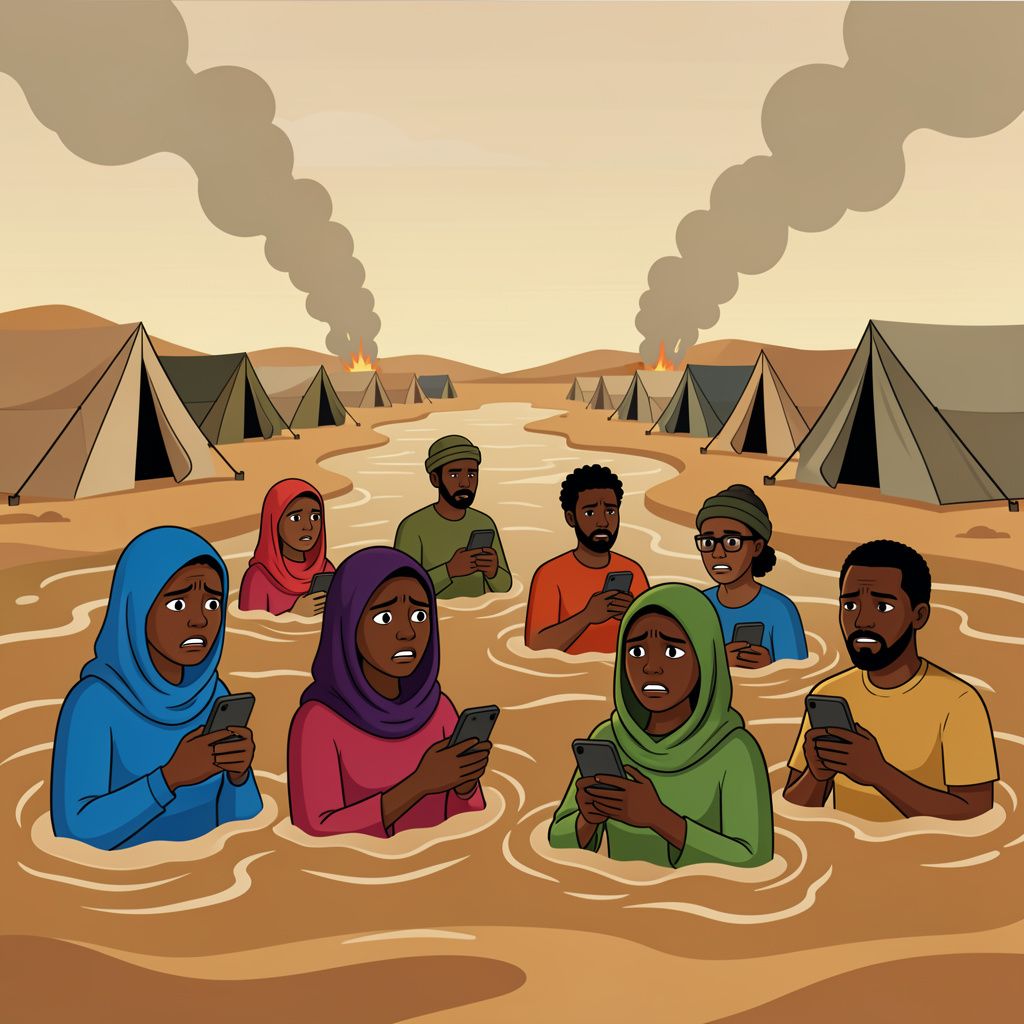
Intensified airstrikes in southern Somalia have stranded thousands of civilians between military bombardments and rising El Niño floodwaters, as humanitarian aid resources collapse to critical lows across the region.
Civilians Trapped Along the Swelling Juba River
The convergence of extreme weather patterns and stepped-up military campaigns has created a catastrophic bottleneck for local populations in southern Somalia [1][3]. In the urban centre of Jilib—a city with an estimated population of 100,000 that serves as the de facto capital for al-Shabaab militants, who control roughly 30% of the country—residents report being pinned down as floodwaters rise rapidly around them [1]. Cayni Ali, a mother of six whose residence sits just 5 metres from the River Juba, recounted that floodwaters had already reached waist height while persistent drone bombardments closed off safe overland evacuation routes [1]. Similar conditions were reported in neighbouring localities such as the village of Malenda, where resident Asho Omar indicated that widespread strikes have made movement virtually impossible amidst civilian casualties [1].
Allegations of Environmental Exploitation and Official AFRICOM Denials
The operational overlap between military activity and seasonal weather reached international attention on Tuesday, 27 October 2026, when reports accused external military forces of weaponising El Niño-induced floods to herd populations into hazardous lowlands [1][3]. Jethro Norman, a senior researcher with the Danish Institute for International Studies, described such tactics as a reversal of remote-sensing applications, shifting environmental monitoring from humanitarian disaster mitigation into lethal pressure mechanisms [1]. Field monitors similarly alleged that aggressive aerial campaigns were steering populations directly into the path of surging floodplains along the river valley [1].
AFRICOM Rebuttal and Broader Operational Realities
In response to these allegations, which were initially highlighted in reporting by The Guardian, the United States Africa Command (AFRICOM) issued an outright denial on 27 October 2026 [3][4][5]. A spokesperson for AFRICOM stated that American forces strictly target legitimate military objectives, implement all feasible precautions to mitigate civilian harm, and do not employ weather phenomena or flooding as instruments of warfare [3][4][5][6]. While analysts such as David Sterman of the New America think tank note that covert actions complicate strike attribution, official records show the US military conducted 11 publicly confirmed strikes between August and October 2026, following operations that eliminated a senior al-Shabaab commander on 1 October 2026 [1]. Strikes attributed to US and Turkish drones have also targeted positions in Kamsuuma, Jamame, and Araare, drawing sustained criticism from trapped residents who maintain they are non-combatants caught in active fire zones [1].
Humanitarian Deficits and Dire Regional Spillover
The acute physical danger unfolds against an eviscerated humanitarian framework, where climate disasters collide with a near-total collapse of financial assistance [1]. Although the 2023 El Niño episode previously displaced over 1,200,000 people and left 19,000 individuals stranded for a full week, the institutional safety net to manage renewed deluges has disintegrated [1][3][5]. Somalia’s international aid budget plummeted precipitously from $2,200,000,000 ($2.2bn) in 2023 down to approximately $300,000 by 2026, representing a severe contraction of -99.986% [1]. Ali Adan Ali, the commissioner for displaced people in Jubaland, reported from Kismayo that while 327 flood-prone zones were mapped, evacuation warnings reached only 163.5 locations by October 2026 due to an acute lack of rescue boats and emergency funding [1].
Cross-Border Vulnerabilities for Displaced Communities
This compounding vulnerability extends directly to frontline medical facilities and cross-border refugee populations [1][GPT]. In Kismayo, an ICRC-supported hospital recorded 205 admissions for weapon-related trauma during 2026—a 43% increase over the previous year’s caseload—alongside a 40% jump in paediatric malnutrition as starving families flee conflict areas [1]. In displacement settlements such as Galbeed camp, community leader Shukri Ahmed estimated that up to 6,000 people may have died since USAID funding rollbacks were enacted [1]. For Somali refugees residing in Kenya’s Kakuma and Kalobeyei settlements who monitor southern Somalia to evaluate spontaneous voluntary returns, these active frontlines and impassable flood zones confirm that cross-border security corridors remain perilous, leaving displaced families and regional host communities to bear the socioeconomic weight of an unresolved dual crisis [1][GPT].
Bronnen
- www.hiiraan.com
- www.facebook.com
- www.hiiraan.com
- www.allbanaadir.org
- www.caasimada.net
- wararka24.com
- www.facebook.com
- www.facebook.com