

Refugee Team Lifts Trophy in Tournament Supporting Kenya's Shirika Integration Plan
Kakuma, 27 October 2026
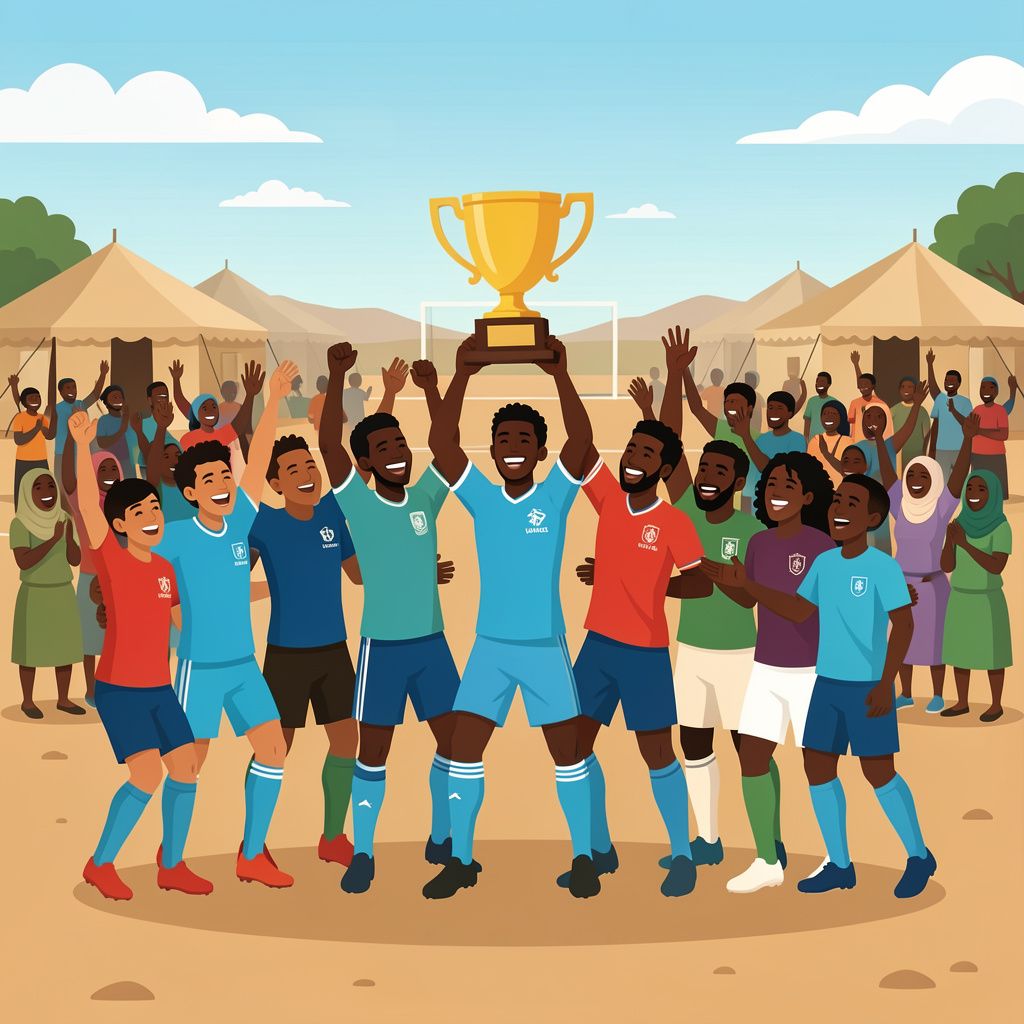
The Great Power FC defeated Morung’ole FC 2–0, demonstrating how sport fosters cohesion as Kenya advances its Shirika Plan to integrate refugees into local economies.
On-Pitch Triumph and Community Spirit in Kakuma
The final of the Kakuma Peacebuilding and Cohesion Football Tournament concluded with The Great Power FC, representing Kakuma Refugee Camp, securing a 2–0 victory over Morung’ole FC, a team drawn from the surrounding host community [1]. The contest reached its decisive rhythm at 4 p.m. when Chito, sporting jersey number 12, broke the deadlock during the first half [1]. Striker Esambo doubled the advantage with a clinical finish in the second half, sealing the championship silverware for the refugee squad [1]. Captain Hamisi expressed deep gratitude towards the organising bodies, remarking that the competition served as an indispensable venue for cultivating solidarity across disparate backgrounds [1]. In kind, the Morung’ole FC captain affirmed that football provides an exceptional instrument for mutual dialogue, binding players and supporters together irrespective of their origins [1].
A Hard-Fought Road to the Final Showdown
The competitive road to the silverware saw four local squads test their tactical mettle across two days of fixtures, supported by an institutional partnership comprising the National Cohesion and Integration Commission (NCIC), the Refugee Consortium of Kenya (RCK), the Department of Refugee Services (DRS), Jesuit Refugee Service (JRS), and AIPG [1]. Morung’ole FC initially booked their final appearance via a marathon penalty shootout, edging Nadapal FC 11–10 following a goalless draw in regular play [1]. Meanwhile, The Great Power FC demonstrated commanding offensive form, defeating 1341 FC by a resounding 4–0 margin in their semi-final clash [1]. In the subsequent third-place playoff on the second day, Nadapal FC rallied to secure a 1–0 win over 1341 FC courtesy of a second-half strike by Master, who wore jersey number 10, capitalising on a scramble after a corner [1].
Economic Inclusion Under the Shirika Plan
Beyond sporting entertainment, the tournament served as a vital grassroots catalyst for Kenya’s progressive Shirika Plan, an overarching framework designed to transition long-term displaced populations away from traditional, segregated camps and towards integrated socio-economic hubs [1][2]. Rosemary Were, Principal Communications Officer at the NCIC, reaffirmed that promoting harmony between host and refugee communities remains pivotal to unlocking these mutual economic possibilities [1]. This transition mirrors broader international priorities, as approximately 14.5 million individuals reside in protracted displacement across developing economies, reliant on direct humanitarian assistance [2]. By empowering displaced residents to participate actively in regional markets, frameworks such as the Shirika Plan present a viable model to move beyond aid dependency, supporting the United Nations High Commissioner for Refugees’ broader target under the ‘50 by 35 vision’ to transition half of all long-term displaced populations into self-reliance by 2035 [2].
Global Funding Gaps and the Case for Self-Reliance
The strategic imperative of fostering sustainable local economies in places like Turkana County comes amidst a constrained international financing environment [1][2]. By early October 2026, the UNHCR had secured approximately US$3 billion against an annual budget requirement of US$8.505 billion, leaving operations functioning on 35.273% of targeted funds [2]. As highlighted during discussions between the High Commissioner and United Kingdom leadership at the University of Oxford on 25 and 26 October 2026, structural deficits necessitate innovative approaches that reduce operational aid duplication and empower communities from the ground up [2]. By bridging social divisions on the pitch, events in Kakuma illuminate how communal trust can establish the foundations necessary for lasting self-reliance and inclusive economic vitality [1][2].