

Iran-Israel War at 100 Days: Why a Regional Conflict Could Affect Global Food Security for Millions
Tehran, 7 June 2026
As the Iran-Israel war marks 100 days today, Iran has fired ballistic missiles at an Israeli air base whilst peace talks remain deadlocked. Most alarmingly, the conflict threatens to push up to 45 million people into acute hunger.
Missiles, Air Bases, and a War That Will Not Stop
On the morning of Sunday, 7 June 2026 — the 100th day of the US-Israel military campaign against Iran — the Israeli army confirmed that missiles had been fired from Iran towards Israel [1]. Iran’s Islamic Revolutionary Guard Corps (IRGC) stated that it had specifically targeted Israel’s Ramat David Air Base with ballistic missiles, framing the strike as a direct response to ongoing Israeli attacks on Lebanon [1]. The assault on Beirut’s southern suburbs earlier the same day, in which Israeli strikes hit at least two buildings in a Hezbollah stronghold, drew immediate condemnation from analysts who warned that such actions risk derailing any remaining prospect of a negotiated settlement [1]. What began as a conflict that US President Donald Trump initially characterised as a limited operation has, over the course of 100 days, transformed into one of the most destabilising regional confrontations the Middle East has witnessed in a generation [GPT].
A Diplomatic Deadlock With Global Consequences
Peace negotiations between Washington and Tehran are, by any credible measure, at a standstill. On 6 June 2026, Mohsen Rezaei, a senior military adviser to Iran’s Supreme Leader, stated in an exclusive CNN interview that a meeting between US President Donald Trump and Mojtaba Khamenei will not happen [4]. Rezaei identified two conditions that he argued must be met before any dialogue can resume: the lifting of the naval blockade imposed on Iran, and the release of $24 billion in frozen Iranian assets, which he described as a necessary ‘test of trust’ [4]. He went further, warning that if military hostilities and the blockade continue, Iran would expand the conflict into the Indian Ocean, the Red Sea, and the Mediterranean by attacking additional American military bases, cautioning that the US ‘would suffer very heavy losses’ [4]. Rezaei urged Trump to make decisions independently of Israel and to place the interests of the American people above all else [4]. These are not the words of a government preparing to negotiate; they are the words of one preparing to escalate.
How the War Has Spread: A Timeline of Regional Escalation
The trajectory of this conflict over its 100 days tells a story of steady and alarming geographic expansion. On 31 May 2026 (Day 94), Israeli ground forces advanced past Lebanon’s Litani River, pushing northward towards the Zahrani River, seizing a strategically significant castle and issuing new civilian displacement orders in the process [3]. The following day, on 1 June 2026, the United States conducted military strikes on Iranian targets while Kuwait intercepted incoming missiles and a broader US-Iran peace deal remained out of reach [3]. By 2 June 2026, warning sirens were activated in Bahrain as fighting surged across the region [3]. On 3 June 2026, US forces conducted strikes on Iran’s Qeshm Island, while Tehran launched attacks against Kuwait and Bahrain — prompting Kuwait to label the Iranian strike a ‘heinous aggression’ [3]. That same day, the US announced that Israel and Lebanon had committed to a ceasefire, following Trump’s efforts on 2 June 2026 to negotiate a truce between Israel and Hezbollah [3]. Yet by 7 June 2026, fresh Israeli strikes on Beirut’s southern suburbs and new Iranian missile launches demonstrated how fragile that commitment remains [1].
45 Million People on the Brink: The Hidden Humanitarian Crisis
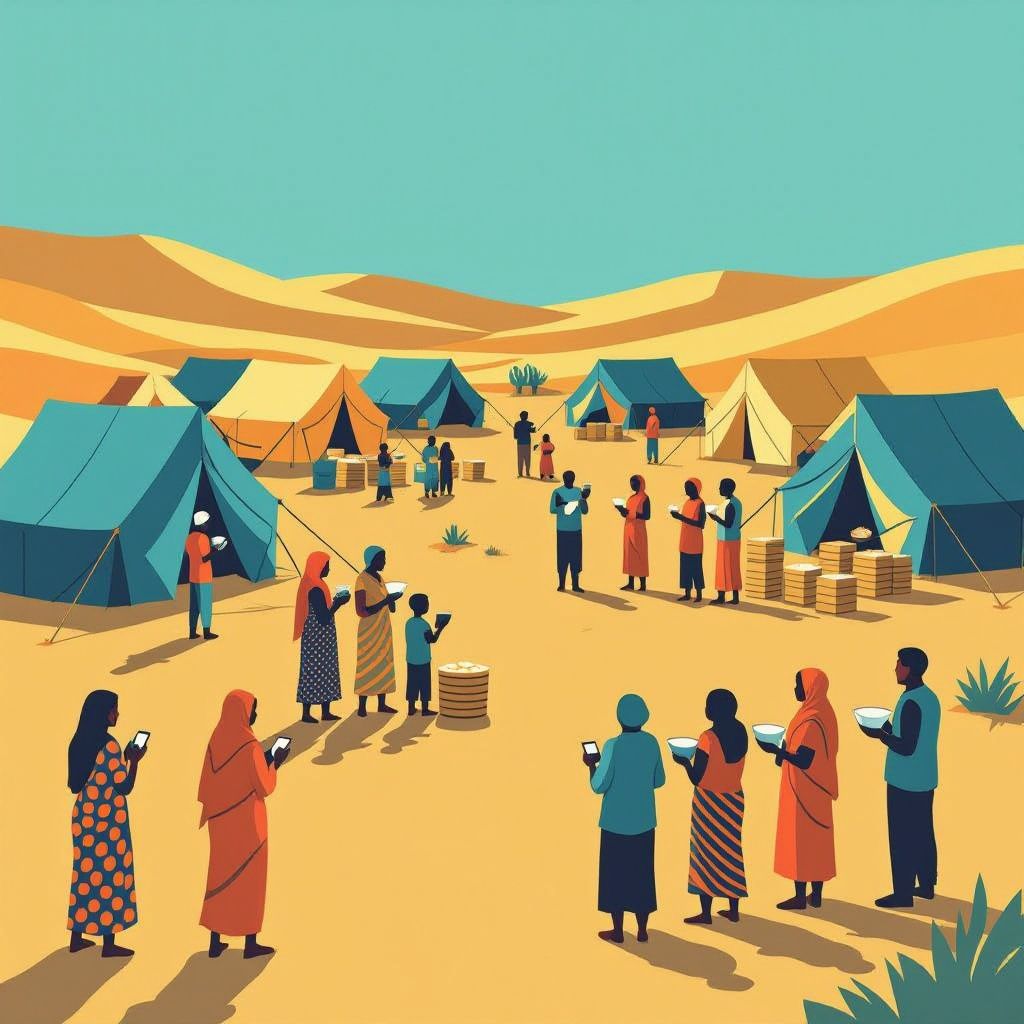
Beyond the military theatre lies a humanitarian emergency of staggering proportions. The US-Israeli war on Iran could tip up to 45 million people into acute hunger [2]. For communities already living on the margins — including refugees in camps such as Kakuma and Kalobeyei in Kenya’s Turkana County — this figure is not an abstraction. The conflict drives global oil prices upward [GPT], which in turn raises the cost of transporting food aid, running generators at health clinics, and operating the supply chains upon which both refugee and host communities depend. Aid organisations are closely monitoring the situation as donor nations redirect political attention and financial resources towards the Middle East, a pattern that historically results in funding shortfalls for operations in East Africa [GPT]. Somali and Ethiopian communities who rely on transit routes through the wider region face compounding instability as the conflict expands [alert! ‘The specific transit routes referenced in the brief are not detailed in the provided sources; the claim is based on editorial context supplied in the task brief rather than a citable source’]. The convergence of a widening war, a diplomatic impasse, and a looming food security catastrophe means that the 100th day of this conflict is not merely a milestone — it is a warning.
What Comes Next: No Clear Path to Peace
With Iran’s IRGC firing ballistic missiles at Israeli air bases on Day 100 [1], the ceasefire commitment announced on 3 June 2026 between Israel and Lebanon appears to be holding only partially and under severe strain [3]. France has been reported as actively attempting to recover its declining diplomatic and political influence in Lebanon as of 3 June 2026, suggesting that European powers are seeking a foothold in any eventual peace process [3]. Yet the core impasse remains: Rezaei’s insistence that Washington release $24 billion in frozen Iranian assets before substantive talks can begin [4] runs counter to the political conditions under which the Trump administration has operated throughout this campaign [GPT]. Pakistan has publicly urged an end to the war [alert! ‘The source cited (Instagram reel from SAMAA TV, 6 June 2026) references Pakistan urging an end to the war in a headline format but provides no detailed content due to the nature of the source’], adding to a growing chorus of international voices calling for de-escalation. For the millions whose food security, safety, and livelihoods hang in the balance — from Beirut’s bombed southern suburbs to the refugee settlements of Turkana — the decisions made in the coming days in Washington, Tel Aviv, and Tehran will carry consequences that extend far beyond the battlefield.